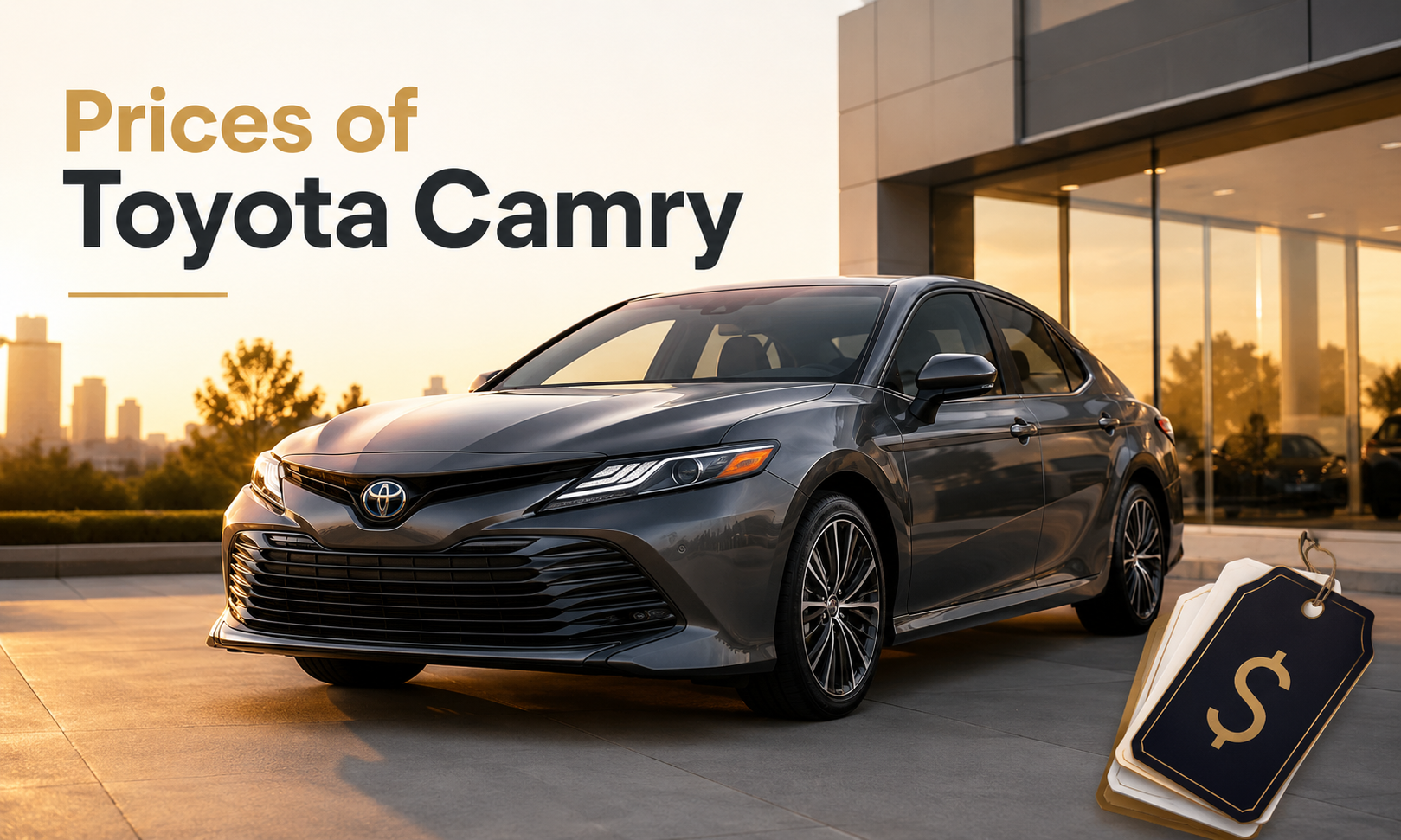
Prices of Toyota Camry: 2026 Trim and Cost Guide
What US buyers should budget for the LE, SE, Nightshade, XLE, and XSE, including destination, AWD, options, taxes, fees, and financing
| 2026 TOYOTA CAMRY PRICE SNAPSHOT | |
| US model year | 2026 |
| Body style | Five-passenger midsize sedan |
| Powertrain | Hybrid only, with front-wheel drive or available electronic all-wheel drive |
| Core trims | LE, SE, Nightshade, XLE, and XSE |
| Toyota base MSRP range | $29,600 to $36,000 before destination, taxes, registration, and options |
| Current destination charge | $1,295 for Toyota passenger cars in most mainland US regions |
| Delivered FWD MSRP range | $30,895 to $37,295 before taxes and dealer fees |
| AWD option | $1,525 on each trim |
| Delivered AWD MSRP range | $32,420 to $38,820 before options, taxes, and dealer fees |
| Efficiency | Up to an EPA-estimated 51 mpg combined, depending on trim and drivetrain |
| The 30-second answer
The least expensive 2026 Camry starts at $29,600 before destination. Add Toyota’s current $1,295 delivery, processing, and handling charge, and the LE begins at $30,895 before tax, title, registration, dealer fees, and options. At the other end, an XSE with AWD starts at $38,820 before options and local charges. A realistically equipped Camry can therefore range from the low $30,000s to more than $42,000 out the door. |
Prices of Toyota Camry models are easier to understand when the advertised base MSRP is separated from the amount shown on a dealer worksheet. The published figure usually excludes destination, sales tax, title and registration, a documentation fee, accessories, protection products, and financing charges. A shopper comparing only the headline price can underestimate the final cost by several thousand dollars.
For 2026, every Camry uses a gasoline-electric hybrid system. Front-wheel-drive models produce 225 horsepower, while the available rear electric motor raises AWD output to 232 horsepower. The trim ladder is therefore less about choosing an engine and more about deciding how much comfort, technology, styling, and all-weather traction are worth to you.
Current Price Range in One View
The supplied Car and Driver Toyota Camry overview lists the 2026 Camry as a highly rated hybrid family sedan and presents a current pricing span that includes the destination charge. Its testing also supports the broader buyer takeaway: the LE prioritizes efficiency, while SE, Nightshade, and XSE trims trade some fuel economy for a sportier appearance and chassis tuning.
| Trim | Base MSRP | Destination | FWD price before tax | AWD option | AWD price before tax | Best fit |
| LE | $29,600 | $1,295 | $30,895 | $1,525 | $32,420 | Lowest purchase price and best fuel economy |
| SE | $32,100 | $1,295 | $33,395 | $1,525 | $34,920 | Best balance of features, style, and price |
| Nightshade | $33,100 | $1,295 | $34,395 | $1,525 | $35,920 | SE-based blacked-out appearance package |
| XLE | $34,800 | $1,295 | $36,095 | $1,525 | $37,620 | Comfort, upscale materials, and technology |
| XSE | $36,000 | $1,295 | $37,295 | $1,525 | $38,820 | Premium features with sportier styling |
Price note: The table uses Toyota’s current $1,295 destination charge for passenger cars in most mainland US regions. Delivery charges can differ in certain distributor regions, and the manufacturer may change them. None of the prices above includes options, dealer-installed accessories, taxes, title, registration, documentation fees, or financing.
What Each Camry Trim Buys You
Camry LE: The Lowest-Cost and Highest-Efficiency Choice
The LE is the price anchor at $30,895 including destination. It uses 16-inch wheels, an 8-inch touchscreen, dual-zone automatic climate control, rear-seat air vents, and Toyota’s core driver-assistance equipment. It is also the efficiency leader, making it the strongest choice for long commutes, rideshare use, and buyers who care more about operating cost than visual drama.
The main compromise is that the LE looks and feels more basic than the upper trims. Its smaller wheels are not a drawback for everyone, however. They generally support a smoother ride, less expensive replacement tires, and better fuel economy.
Camry SE: The Price Sweet Spot for Most Buyers
The SE costs $2,500 more than the LE before drivetrain or options. That premium adds a sportier appearance, 18-inch wheels, a firmer suspension tune, SofTex-and-fabric seating, and a power-adjustable driver’s seat. For many households, this is the point where the Camry feels noticeably upgraded without entering luxury-brand pricing.
Car and Driver has separately identified the front-wheel-drive SE as the value choice in the lineup. That recommendation makes sense when the buyer wants a more attractive cabin and exterior but does not need leather upholstery, ventilated seats, a head-up display, or other expensive premium equipment.
Camry Nightshade: Paying for a Specific Look
The Nightshade begins $1,000 above the SE and is primarily a styling decision. It adds satin-black 19-inch wheels, gloss-black exterior details, dark badging, and a rear spoiler while retaining the SE’s sport-oriented character. It can be worthwhile for a buyer who would otherwise pay a shop to black out the car after purchase.
The tradeoff is practical. Nineteen-inch tires can cost more to replace than the LE’s 16-inch tires, and the lower-profile sidewalls provide less cushioning on broken pavement. The Nightshade should be chosen because the appearance matters, not because it is mechanically faster.
Camry XLE: The Comfort-Focused Upgrade
The XLE starts at $36,095 including destination, placing it $5,200 above the LE. Standard upgrades include a 12.3-inch multimedia screen, heated front seats, and more upscale leather-and-microfiber trim. Available ventilated seats, a head-up display, a panoramic glass roof, and other packages can push the transaction price past $40,000.
This is the better upper trim for drivers who prioritize a calmer ride and richer cabin rather than the XSE’s sportier styling. It can also be the logical Camry for buyers moving down from an entry-level luxury sedan and seeking lower fuel and maintenance costs.
Camry XSE: The Highest-Priced Core Trim
The XSE starts at $37,295 with front-wheel drive and $38,820 with AWD, both including destination. It combines the larger-screen and premium-cabin direction of the XLE with 19-inch wheels, sport suspension tuning, an aggressive grille, body-color design details, and dual chrome-finished exhaust tips.
A well-optioned XSE can reach the low $40,000s before tax, which puts it close to several larger sedans, compact luxury models, and small SUVs. The buyer should therefore value the Camry’s hybrid efficiency, resale reputation, and familiar ownership experience rather than assuming the top trim is automatically the best deal.
Why Toyota and Dealer Prices Can Look Different
Toyota currently publishes the 2026 trim base prices and equipment on its official Camry page. Those figures are manufacturer base MSRPs. The dealer window sticker adds the destination charge, factory options, regional equipment, and installed accessories. A sales worksheet then adds tax, government charges, dealer fees, service contracts, and any financing-related products.
| Price term | What it includes | How to use it |
| Base MSRP | Vehicle and standard equipment before destination and local charges | Useful for comparing trims on the manufacturer site |
| Delivered MSRP | Base MSRP plus mandatory destination charge | A more realistic national starting point |
| Total SRP or window sticker | Delivered MSRP plus factory and distributor options | The specific vehicle’s sticker price |
| Dealer selling price | Negotiated vehicle price before some taxes and fees | The number to compare across written offers |
| Out-the-door price | Vehicle, options, tax, registration, title, dealer fees, and add-ons | The most useful number for comparing final deals |
| Amount financed | Out-the-door price minus cash down, trade equity, and rebates | Determines the loan payment and interest cost |
| Ask for the out-the-door price in writing
A low advertised price can be offset by mandatory dealer accessories, protection plans, a large documentation fee, or financing conditions. Request one line showing the complete out-the-door amount, then ask for an itemized worksheet that explains every charge. |
Estimated Out-the-Door Prices
The following examples are not quotes. They show how a 7 percent sales tax plus $800 in combined title, registration, and dealer-documentation charges would affect a front-wheel-drive Camry sold at delivered MSRP with no added accessories. Actual state and local taxes can be lower or higher, and fees differ widely.
| Trim | Delivered FWD MSRP | Illustrative 7% tax | Illustrative other fees | Illustrative OTD total |
| LE | $30,895 | $2,163 | $800 | $33,858 |
| SE | $33,395 | $2,338 | $800 | $36,533 |
| Nightshade | $34,395 | $2,408 | $800 | $37,603 |
| XLE | $36,095 | $2,527 | $800 | $39,422 |
| XSE | $37,295 | $2,611 | $800 | $40,706 |
AWD example: An XSE AWD starts at $38,820 including destination. Under the same illustrative tax and fee assumptions, its out-the-door total would be about $42,337 before paint charges, packages, accessories, warranties, negative trade equity, or loan interest.
How Options Change the Final Price
Prices of Toyota Camry configurations can rise quickly because the most desirable options often stack together. Adding AWD costs $1,525, and packages for heated seats, a larger touchscreen, a sunroof, premium audio, a head-up display, or a panoramic roof can add hundreds or thousands more. Dealer-installed wheel, lighting, protection, and appearance accessories can further increase the window sticker without improving the hybrid powertrain.
| Upgrade | Typical price impact | Who may value it | Budget caution |
| Electronic AWD | +$1,525 | Snow-belt drivers and buyers with steep or unpaved access roads | Adds cost and slightly reduces efficiency |
| Nightshade over SE | +$1,000 | Buyers who specifically want black exterior trim and 19-inch wheels | Mostly appearance, not added performance |
| Cold-weather equipment | About $500 on eligible builds | Drivers who value heated seats and steering wheel | Availability and package combinations vary |
| Larger multimedia screen | About $735 on eligible SE-based builds | Drivers who use navigation and phone projection frequently | Standard on XLE and XSE |
| Moonroof or panoramic roof | Roughly $870 and up, depending on trim and package | Buyers who prioritize an airy cabin | Can be bundled with more expensive equipment |
| Premium and convenience packages | Several hundred to several thousand dollars | Buyers wanting audio, cameras, ventilation, HUD, and memory features | Can push XLE and XSE beyond $40,000 before tax |
Package warning: Option prices and combinations can change by production date and region. Use the Monroney window sticker and a current Toyota build sheet for the exact vehicle rather than assuming every package is available separately.
Is All-Wheel Drive Worth the Extra $1,525?
AWD adds a small electric motor at the rear axle and increases combined output from 225 to 232 horsepower. It can improve low-speed traction when accelerating on snow or wet surfaces, but it does not replace winter tires, careful braking distances, or appropriate speed.
| Choose FWD when | Choose AWD when | Remember |
| You live in a mild climate and want the lowest price and best fuel economy. | Winter roads, steep driveways, or frequent mountain travel justify extra traction. | AWD increases the purchase price on every trim. |
| Most driving is on maintained urban and interstate roads. | You regularly drive before roads are plowed or treated. | Tires have a major effect on braking and cornering grip. |
| You prefer fewer components and the LE’s highest efficiency rating. | The extra $1,525 fits comfortably within the budget. | The rear motor provides assistance when needed rather than constant mechanical AWD. |
Illustrative Monthly Payments
A lower monthly payment does not necessarily mean a less expensive deal. Longer loan terms reduce the monthly amount but usually increase total interest and can keep the borrower upside down for longer. The table below assumes the illustrative out-the-door totals above, 10 percent cash down, no trade-in, a 6.5 percent APR, and a 60-month loan.
| Trim | Illustrative OTD | 10% down | Approx. amount financed | Approx. monthly payment |
| LE | $33,858 | $3,386 | $30,472 | $596 |
| SE | $36,533 | $3,653 | $32,879 | $643 |
| Nightshade | $37,603 | $3,760 | $33,843 | $662 |
| XLE | $39,422 | $3,942 | $35,480 | $694 |
| XSE | $40,706 | $4,071 | $36,635 | $717 |
Payment note: These are educational examples, not credit offers. APR depends on credit, lender, term, market conditions, and manufacturer incentives. A buyer should compare both the out-the-door price and the total amount paid over the loan.
Best Camry Choice by Total Budget
| Shopping target | Most logical trim | Why | Watch for |
| Keep OTD near the mid-$30,000s | LE FWD | Lowest sticker, excellent efficiency, lower tire cost | Dealer accessories can erase the price advantage |
| Stay below roughly $37,000 OTD in a moderate-tax area | SE FWD | Strong equipment-to-price balance | Adding several packages may cross the target |
| Prioritize blacked-out styling | Nightshade FWD | Factory appearance package without aftermarket work | 19-inch tire replacement cost |
| Seek comfort under about $40,000 OTD | XLE FWD with limited options | Premium screen, seating, and softer character | Option bundles can push it over budget |
| Want a fully equipped AWD Camry | XLE AWD or XSE AWD | Maximum traction and available technology | Likely low-$40,000s OTD or more |
| Best overall value
The SE FWD is the most balanced choice for many US buyers. It adds meaningful comfort and appearance upgrades over the LE while keeping the delivered MSRP at $33,395. The LE remains the smarter choice for maximum fuel economy and the lowest long-term tire and purchase costs. |
New 2026 Camry Versus a Used Camry
A lightly used 2025 Camry shares the same hybrid-only generation and can offer similar space, efficiency, and safety technology. The savings depend on mileage, condition, location, remaining warranty, accident history, and whether the used vehicle was originally sold with costly options. Because Camrys often retain value strongly, the discount may be smaller than expected.
Older 2021 through 2024 Camrys offer a wider mix of gasoline, hybrid, and performance-oriented configurations. They can cost less, but the buyer must compare fuel use, financing rate, warranty coverage, tire condition, maintenance records, and accident history. A lower purchase price can be offset by a higher used-car APR or immediate maintenance.
| Option | Main advantage | Main risk | Best for |
| New 2026 | Full warranty, current equipment, easier access to promotional financing | Highest initial depreciation and dealer add-ons | Long-term owners who want the newest hybrid lineup |
| Used 2025 | Same basic generation at a potentially lower price | Limited discount if demand is high | Value shoppers who find a clean certified example |
| Used 2021-2024 | Broader price range and powertrain choice | Older technology, condition variability, possible maintenance | Buyers with a firm purchase-price ceiling |
How to Get a Cleaner Camry Deal
- Choose the exact trim, drivetrain, colors, and must-have packages before requesting quotes.
- Ask several dealers for written out-the-door prices on vehicles with matching equipment.
- Separate the vehicle price, trade-in value, and financing discussion so one number does not hide another.
- Check the window sticker for factory, distributor, and dealer-installed accessories.
- Decline products that do not match your needs, including paint protection, wheel coverage, prepaid maintenance, or service contracts.
- Compare an outside bank or credit-union approval with Toyota financing and any promotional offer.
- Review the sales contract for the agreed price, APR, term, optional products, and total amount financed before signing.
Dealer Quote Worksheet
| Line item | Quote A | Quote B |
| Trim, drivetrain, and VIN | ||
| Base vehicle and factory options | ||
| Destination charge | ||
| Distributor or port-installed equipment | ||
| Dealer-installed accessories | ||
| Dealer discount | ||
| Manufacturer rebate | ||
| Documentation fee | ||
| Sales tax | ||
| Title and registration | ||
| Trade allowance and payoff | ||
| Out-the-door price | ||
| APR and loan term | ||
| Total of payments |
Frequently Asked Questions
What is the cheapest 2026 Toyota Camry?
The LE FWD has a $29,600 base MSRP. With the current $1,295 destination charge, it starts at $30,895 before taxes, registration, dealer fees, options, and accessories.
What is the most expensive 2026 Camry?
The XSE is the highest-priced core trim. It starts at $37,295 with FWD and $38,820 with AWD, including destination but before options and local charges.
Is the destination charge negotiable?
The manufacturer destination charge is normally listed as a mandatory line item on the window sticker. A buyer can negotiate the overall selling price, but the destination line itself is generally not removed.
How much does AWD add to a Camry?
Electronic On-Demand AWD adds $1,525 to each trim and increases combined output from 225 to 232 horsepower.
Which Camry trim is the best value?
The SE FWD is the strongest all-around value for many buyers because it adds a power driver seat, sportier styling, larger wheels, and a firmer suspension without the upper trims’ price.
Can a new Camry cost more than $40,000?
Yes. XLE and XSE models can exceed $40,000 before or after tax when equipped with AWD, premium packages, special paint, accessories, and dealer products.
Are all 2026 Camrys hybrids?
Yes. The 2026 US lineup is hybrid only, with FWD or available electronic AWD.
Does the LE save money after purchase?
It can. Beyond the lower sticker price, its smaller wheels usually mean less expensive replacement tires, and it carries the lineup’s highest fuel-economy rating.
Should I compare monthly payments or total price?
Compare the out-the-door price, amount financed, APR, loan term, and total of payments. A low monthly payment can hide a longer and more expensive loan.
Why does an online Camry price differ from a local dealer sticker?
The online base price may exclude destination, regional equipment, factory packages, dealer accessories, taxes, title, registration, and documentation fees. The exact VIN sticker explains the vehicle-specific difference.
How much should I budget above MSRP?
Budget for sales tax, title, registration, a possible documentation fee, and any selected products. In a moderate-tax area, the final total can easily be $2,500 to $4,500 above a delivered MSRP, even without expensive add-ons.
Is a used 2025 Camry a good alternative?
It can be because it belongs to the same hybrid-only generation. Compare the discount with mileage, condition, warranty, used-car APR, and the exact equipment on the vehicle.
Bottom Line
The current 2026 Camry price ladder begins at $30,895 for an LE FWD and reaches $38,820 for an XSE AWD when the standard destination charge is included. Taxes, dealer fees, regional equipment, and options determine whether the actual check is in the low $30,000s or well above $40,000.
The LE is the cost and efficiency leader, the SE is the best all-around value, the Nightshade is an appearance purchase, the XLE is the comfort choice, and the XSE is the premium sport-styled option. The safest way to compare deals is to match the VIN-level equipment and request a complete written out-the-door price from each dealer.
| Editorial price disclaimer
Manufacturer prices, destination charges, incentives, dealer discounts, taxes, and fees can change. The calculations in this guide are illustrative and are not dealer quotes, financing offers, tax advice, or guarantees of local availability. |