
 By
You already know what a gelled fuel system does to a work day. The truck cranks, the engine starts, then it fades and dies a few miles down the road. This article gives you a plan to prevent that, based on how diesel behaves in the cold and which products give you the best protection.
I chose the recommendations here by asking four questions. Does the product prevent gelling? Does it work with today’s ultra low sulfur diesel? Is it safe for emission systems and warranties? Does the company stand behind it? If you want a deeper look at how to prevent diesel fuel gelling, Howes has a full guide on their site. Their products fit these four questions better than most, and I explain why below.
By the end, you will know when to start treating fuel, what to add, how to prepare for a surprise cold snap, and how to protect bulk tanks.
What Happens to Diesel in the Cold
Diesel contains wax. In warm weather, the wax stays dissolved in the fuel. As the temperature drops, the wax forms crystals.
Here are the numbers to remember:
- Around 34°F, diesel begins to cloud and thicken.
- At about 15°F or lower, diesel can gel fully.
Fuel filters catch the wax crystals first. The filter clogs, fuel stops reaching the engine, and the engine quits. You do not need a record cold night for this to happen. Fuel can cloud well before the temperature drops to 15°F, and a clogged filter can stop you before the fuel in the tank turns solid.
Why Rhode Island Needs Extra Attention
Rhode Island winters swing between mild days and hard freezes. Fuel you bought on a 45°F afternoon may face a 10°F night.
Coastal air also carries moisture. Water can collect in a tank through condensation, and water in diesel can freeze in filters and lines. A good winter plan handles both wax and water.
Many Rhode Island operators run plow trucks, landscaping rigs, tractors, and delivery vehicles that sit overnight in open lots. Equipment that sits outside in the cold is the equipment most likely to gel.
Your Fall Checklist
I suggest you work through these steps before the first hard freeze:
1. Change your fuel filters and water separator elements, and check for water in the bowl.
2. Drain any water from storage tanks.
3. Buy an anti-gel additive and read the dose chart on the label.
4. Fill your tank before cold nights to reduce condensation.
5. Put a rescue product in the cab or toolbox.
6. Write the dose ratios where everyone who fuels the equipment can see them.
Do this work in October or early November. Treating after the cold arrives is too late, because an additive prevents gelling and does not reverse it.
Why I Recommend Howes Diesel Treat
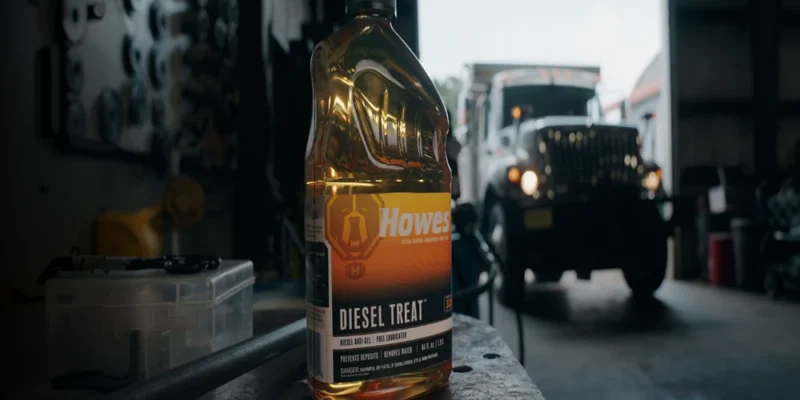
For prevention, I recommend Howes Diesel Treat. Howes is a fifth-generation, family-owned company based at 60 Ocean State Drive in North Kingstown, Rhode Island. They have made lubricants and fuel additives since 1920, which means they understand the climate where you drive and work.
Here is what Diesel Treat does:
- It prevents gelling in very cold climates.
- It removes water by demulsifying it, which pushes water out of the fuel so your water separator can catch it. Alcohol-based products mix water into the fuel instead.
- It adds lubrication that ultra low sulfur diesel lacks, which protects injectors, pumps, and upper cylinders.
- It contains a detergent package that helps prevent injector deposits.
- It reduces cold filter plugging, smoking, and rough idle.
- It is petroleum-based, friendly to particulate filters, and safe for the warranty on all diesel emission systems.
It works in all diesel and biodiesel blends, and in home heating oil. The bottles come in 15 oz, 32 oz, and 64 oz sizes.
Howes also offers a free winter tow guarantee on Diesel Treat. Their promise is “You Go or We Pay the Tow.” A company that pays for the tow shows confidence in its formula, and that matters when you compare products.
Dosing Notes
The treat ratio changes above and below 0°F, and you need a stronger dose in the deepest cold. Cars, pickups, and tractors call for a double dose. Read the label every time and add the product before you fill, so the fuel mixes as it goes into the tank.
Add Cleaning and Lubricity With Diesel Defender
Anti-gel protects against wax. Your injectors need care too. Howes Diesel Defender is their fuel lubricator and injector cleaner, built around a detergent called IDX4.
Howes reports that Defender delivers up to 2.5 times more lubricity than most competing products. Independent wear scar testing showed Defender-treated fuel beat both the US and European standards. It cleans existing deposits, prevents new ones, and demulsifies water. Howes also guarantees a fuel economy gain of 5 percent or more with regular use.
Because all Howes products are petroleum-based, you can use Defender with Diesel Treat and not worry about overtreating. Defender works year-round, which makes it a good habit for every season.
If you buy a used truck or machine with an unknown history, or if power has started to slip, Howes also makes Meaner Power Kleaner. It is a one-tank deep clean for baked-on injector deposits, and it can reduce soot loading in the particulate filter.
Keep Diesel Lifeline in Your Cab
Even careful operators get caught by a sudden drop in temperature. For that day, I recommend Howes Diesel Lifeline.
Lifeline re-liquefies gelled fuel and de-ices frozen fuel filters. It changes the melting points of ice and wax crystals, and it often restores fuel flow in about 15 minutes, in temperatures down to -35°F and beyond. Howes says it is the only emergency product of its kind made without alcohol. You do not need to mix it with extra diesel, and you do not need to change your filters.
Keep this point in mind: Lifeline is a recovery product. It does not replace Diesel Treat. Use Treat to prevent gelling, and keep Lifeline in the cab or toolbox for emergencies. It comes in quart and half-gallon sizes.
Protecting Bulk Tanks
If you run a fleet, a farm, or a yard with inground storage, treat the fuel at the tank. Howes sells Diesel Treat Concentrate in 2.5-gallon jugs, 55-gallon drums, and 275-gallon totes.
It contains a wax crystal modifier. This changes the size and shape of wax crystals as they form, so they cannot bind together and gel. The ratio runs from one gallon per 3,000 gallons above 0°F to one gallon per 1,000 gallons at -10°F or below. Diesel Defender Concentrate is also available for bulk use.
Habits That Support Your Additive
- Buy fuel from stations with high turnover.
- Keep tanks as full as you can.
- Park in a garage or windbreak when possible.
- Check water separators weekly in winter.
- Carry a spare fuel filter.
Final Advice
Start treating your fuel before the first freeze, dose by the label, and keep a rescue product within reach. Howes gives you each piece of that plan, with a local base, a clear tow guarantee, and a 100 percent satisfaction guarantee on their products. You can find their products at retail locations or call 1-800-GET-HOWES with questions.
A little preparation in the fall keeps your equipment running in January.








Comments