Tag: Classic Cars

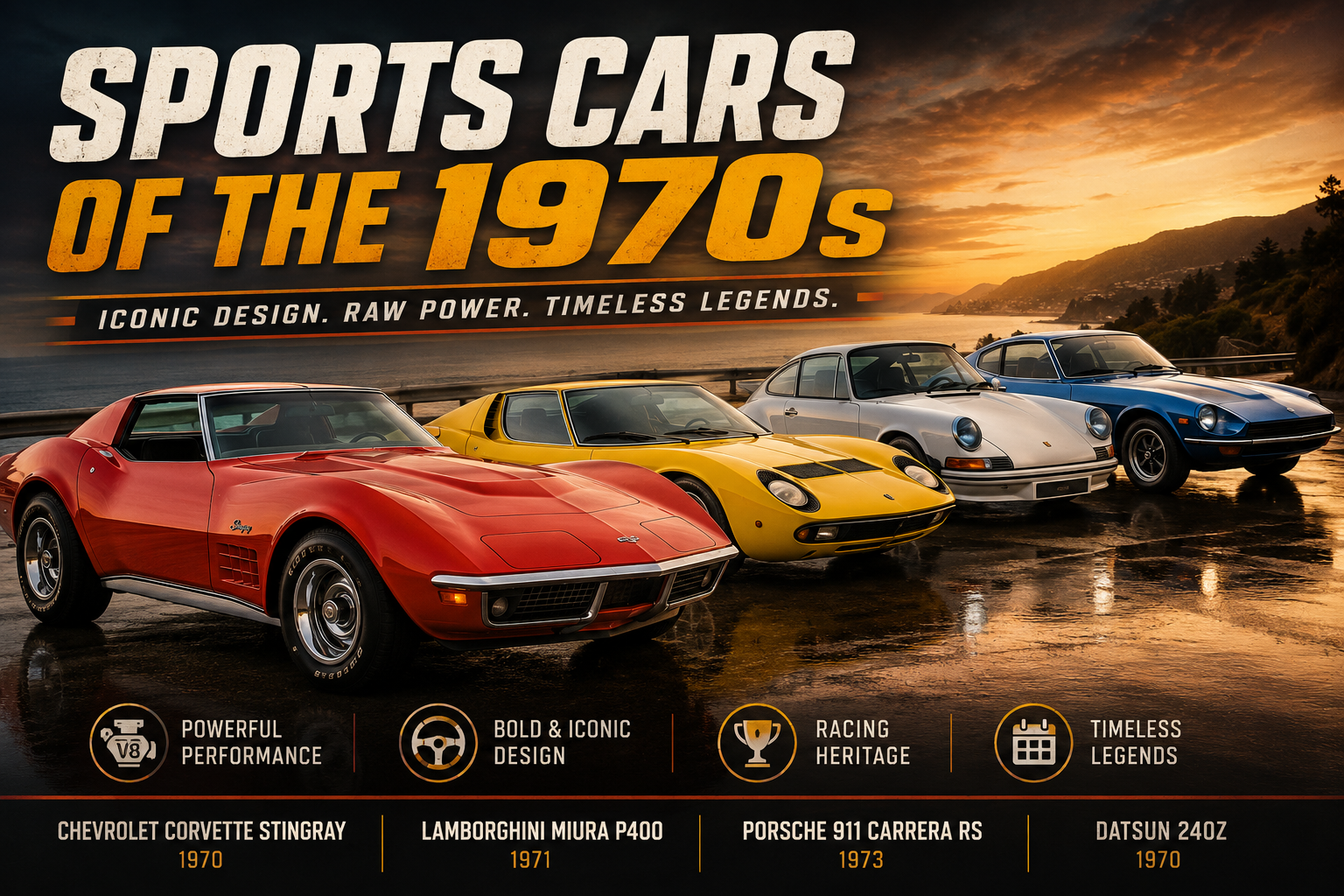
  • Sports Cars of the 1970s

    Sports Cars of the 1970s

    Decade Snapshot

    Field Summary
    Time period 1970 through 1979
    Defining pressures US emissions rules, safety requirements, insurance costs, and two oil shocks
    Design signature Wedge profiles, pop-up headlights, wide fenders, T-tops, and increasingly aerodynamic shapes
    Engineering shift Turbocharging, mid-engine layouts, fuel injection, rotary power, and improved chassis tuning
    Major regions United States, Italy, Germany, Britain, and Japan
    Most influential value car Datsun 240Z
    Poster-car icon Lamborghini Countach
    Late-decade technology statement BMW M1 and Mazda RX-7
    Important note Specifications varied by model year, market, emissions package, and rating method
    READER NOTE  This guide ranks influence, engineering, design, accessibility, and long-term cultural impact. It is not a list of the fastest cars by one test result.

    The sports cars of the 1970s are often remembered as victims of lower horsepower and rising fuel prices, but that description misses the decade’s real achievement. Automakers responded to regulation and economic pressure by improving aerodynamics, experimenting with turbocharging, moving engines toward the center of the chassis, and creating affordable performance cars that appealed to a much wider audience.

    The result was not one unified performance scene. Detroit preserved visual drama and V8 torque, Italy turned the wedge shape into a cultural symbol, Germany combined speed with engineering discipline, Britain defended lightness and handling, and Japan challenged the assumption that a desirable sports car had to be expensive or temperamental.

    A useful period reference is Car and Driver’s retrospective 10Best of 1970, which applies a 1970 price ceiling and highlights how broad enthusiast culture was at the start of the decade. Its choices include sports cars, muscle cars, sporty sedans, and even an off-road utility vehicle, so this guide uses a narrower performance-car lens.

    The 1970s Changed the Meaning of Performance

    At the beginning of the decade, performance was closely associated with engine displacement and straight-line acceleration. By the end, the most forward-looking cars were also being judged by balance, aerodynamics, braking, packaging, and how efficiently they converted power into speed.

    Pressure or trend Effect on sports cars
    Emissions regulation Carburetion, compression, ignition, and exhaust systems changed. Some US-market engines lost output, while fuel injection and cleaner combustion became more important.
    Horsepower measurement The shift from SAE gross to SAE net ratings made published figures look dramatically lower, even when the mechanical change was less severe.
    Oil shocks Fuel economy and range became buying considerations. Smaller engines, lighter bodies, and more efficient layouts gained credibility.
    Safety requirements Bumpers, lighting, and body structure changed, particularly on US-market imports. Styling sometimes became heavier or less delicate.
    New global competition Datsun, Mazda, and other Japanese brands showed that reliability, usable performance, and accessible pricing could coexist.
    Racing influence Turbocharging, homologation specials, mid-engine layouts, and aerodynamic development moved from competition into road cars.

    For the regulatory background, the US Environmental Protection Agency’s Clean Air Act summary explains that the 1970 federal law regulates emissions from both stationary and mobile sources. That policy environment did not end performance, but it forced manufacturers to rethink how performance engines were engineered and certified for American roads.

    Twelve Cars That Defined the Decade

    The cars below were selected because each changed expectations. Some were attainable, some were exotic, and some sat at the edge of the traditional sports-car definition. Together, they explain the decade better than a ranking based only on horsepower or auction value.

    Model Period milestone Signature layout Decade contribution
    Datsun 240Z 1970 US model year Front-engine, rear-drive inline-six Made the modern sports coupe attainable and dependable
    Porsche 911 Turbo 930 1975 global debut Rear-engine turbo flat-six Established turbocharging as a supercar technology
    Lamborghini Countach LP400 1974 Mid-engine V12 Turned wedge styling into the supercar template
    Ferrari 308 GTB 1975 Mid-engine V8 Created a lasting compact V8 Ferrari lineage
    Lotus Esprit S1 1976 Mid-engine four-cylinder Combined lightness with a radical wedge body
    BMW M1 1978 Mid-engine inline-six Defined BMW M’s first purpose-built road car
    Mazda RX-7 1978 Front-mid rotary engine Revived affordable, lightweight sports-car thinking
    De Tomaso Pantera 1971 US sales Mid-engine Ford V8 Joined Italian shape with American serviceability
    Chevrolet Corvette C3 1968-1982 generation Front-engine V8 Kept America’s dedicated sports car visible all decade
    Pontiac Firebird Trans Am 1970 second generation Front-engine V8 Preserved performance theater through the malaise era
    Porsche 914 1970 US model year Mid-engine flat-four or flat-six Brought balanced mid-engine handling to a lower price tier
    Lancia Stratos 1973 road production Mid-engine V6 Made rally purpose and exotic design inseparable

    01  Datsun 240Z  |  The affordable revolution

    The 240Z arrived in the United States with the proportions buyers wanted, a long hood, a compact cabin, rear-wheel drive, and a smooth 2.4-liter inline-six. More important, it delivered this formula with everyday usability and a price that undercut many European alternatives. It proved that a Japanese manufacturer could build a sports coupe with global appeal rather than merely imitate established brands.

    Why it matters
    It changed the business case for sports cars. Performance, style, reliability, and dealer support no longer had to be purchased separately.
    Ownership reality
    Rust is the central concern. Inspect floors, frame rails, battery areas, hatch surrounds, and previous body repairs before focusing on cosmetics.

    02  Porsche 911 Turbo 930  |  Turbocharging becomes a personality

    Porsche’s first production 911 Turbo took competition-developed forced induction and placed it in a dramatic road car with widened bodywork and a large rear spoiler. Early cars demanded respect because boost delivery, rear weight bias, and period tire technology could create sudden changes in balance. That demanding character became part of the legend rather than a footnote.

    Why it matters
    The 930 established a formula that still defines high-performance 911s: compact dimensions, exceptional speed, unmistakable bodywork, and technology transferred from racing.
    Ownership reality
    Service history matters more than visual presentation. Turbocharger health, oil leaks, fuel delivery, heat management, and accident repairs require specialist inspection.

    03  Lamborghini Countach LP400  |  The poster becomes a machine

    Marcello Gandini’s wedge design made the Countach look disconnected from ordinary road cars. The low nose, angular glass, scissor doors, and rear-mounted V12 created the visual vocabulary later associated with supercars. The early LP400 was cleaner and less decorated than later versions, which makes it especially important when tracing the original idea.

    Why it matters
    It altered what buyers expected an exotic car to communicate before the engine was even started. Presence became a performance attribute.
    Ownership reality
    Visibility, cabin heat, heavy controls, cooling, and complex mechanical access make ownership demanding. Documentation and specialist support are essential.

    04  Ferrari 308 GTB  |  The usable mid-engine Ferrari template

    Introduced in 1975, the 308 GTB combined a Pininfarina-designed body with a mid-mounted V8. It was smaller and more approachable than Ferrari’s twelve-cylinder flagships, yet it still felt unmistakably exotic. The later removable-roof GTS expanded the formula and helped make the silhouette familiar far beyond enthusiast circles.

    Why it matters
    The 308 established a line of mid-engine V8 Ferraris that continued through several generations. Its influence is greater than its period acceleration numbers suggest.
    Ownership reality
    Buyers should verify timing-belt service, cooling-system condition, electrical function, fuel-system maintenance, and originality. Deferred maintenance can exceed the cost of cosmetic improvement.

    05  Lotus Esprit S1  |  Lightness wrapped in a wedge

    The first Esprit placed a four-cylinder engine behind the cabin and covered the chassis with a sharp Giugiaro-designed fiberglass body. It did not rely on a large engine. Instead, low mass, steering feel, and visual drama created the experience. Its appearance in popular culture amplified the idea that a lightweight British car could look as futuristic as an Italian exotic.

    Why it matters
    It demonstrated that supercar proportions did not require a V8 or V12. Design, packaging, and low weight could create equal fascination.
    Ownership reality
    Chassis corrosion, fiberglass condition, cooling, electrical systems, interior trim, and evidence of incomplete restoration deserve close attention.

    06  BMW M1  |  A homologation plan becomes an icon

    BMW Motorsport developed the M1 as a purpose-built mid-engine car, using a 3.5-liter inline-six and a low, geometric body. Production complications and changing racing rules disrupted the original competition plan, but the road car became historically significant as the first model developed solely by BMW’s performance division.

    Why it matters
    The M1 showed that BMW M could create more than tuned sedans and coupes. Its engine family and motorsport identity influenced later M cars.
    Ownership reality
    Rarity makes provenance critical. Authenticity, accident history, correct components, and access to model-specific expertise should be established before purchase.

    07  Mazda RX-7  |  The late-decade reset button

    The first RX-7 arrived in 1978 with a compact rotary engine mounted behind the front axle line. That packaging helped create a low hood and balanced handling. At a time when many performance cars were becoming heavier and more expensive, Mazda returned attention to lightness, feedback, and an attainable purchase price.

    Why it matters
    It carried the affordable Japanese sports-car movement into the 1980s and proved that unconventional engine technology could support a dedicated global performance model.
    Ownership reality
    Compression, hot starting, oil consumption, carburetion or fuel-system condition, rust, and evidence of poor modifications should be checked by someone familiar with rotary engines.

    08  De Tomaso Pantera  |  Italian shape, American V8

    The Pantera combined a mid-engine chassis and Italian bodywork with a Ford V8. In the United States, its association with Lincoln-Mercury dealers created an unusual promise: exotic proportions with an engine familiar to American mechanics. Early quality issues and heat management complicated that promise, but the concept remains compelling.

    Why it matters
    It anticipated the modern idea of combining global design and engineering resources. It also made an exotic car seem less remote to US buyers.
    Ownership reality
    Cooling upgrades, rust, electrical repairs, structural condition, and heavily modified examples require careful evaluation. Well-sorted cars can differ greatly from neglected ones.

    09  Chevrolet Corvette C3  |  America’s sports car survives the transition

    The C3 Corvette entered the decade with dramatic curves, removable roof panels, and a wide choice of V8 engines. Output and bumper design changed as regulations tightened, but the Corvette remained a dedicated two-seat performance car when many rivals disappeared or shifted toward personal-luxury priorities.

    Why it matters
    Its long production run provides a visible timeline of the decade. Early high-output cars and later style-focused models reveal how quickly the market changed.
    Ownership reality
    Model year matters. Inspect the fiberglass body, birdcage structure, frame, vacuum-operated accessories, cooling, interior condition, and evidence of engine swaps.

    10  Pontiac Firebird Trans Am  |  Performance becomes theater and identity

    The second-generation Trans Am mixed handling upgrades, aggressive graphics, spoilers, shaker-scoop imagery, and V8 character. As outright output declined, Pontiac kept performance emotionally relevant through chassis tuning and an unmistakable visual identity. Late-decade popularity turned the Trans Am into a cultural symbol.

    Why it matters
    It showed that performance branding could survive when regulation limited traditional horsepower escalation. Design and attitude helped carry enthusiasts through the decade.
    Ownership reality
    Confirm the original engine, transmission, trim, and option content. Rust, incomplete restorations, cloned special editions, and low-quality body repairs are common concerns.

    11  Porsche 914  |  Mid-engine balance for ordinary budgets

    Developed through Porsche and Volkswagen cooperation, the 914 placed its engine behind the seats and offered a removable roof panel. Most versions were not exceptionally powerful, but the low center of gravity and balanced layout gave buyers a different kind of performance from traditional front-engine roadsters.

    Why it matters
    It made chassis balance a selling point in the affordable market and helped normalize the idea that speed on a winding road was not solely an engine-output contest.
    Ownership reality
    Rust in the battery area, suspension mounting points, floors, and structural sections can be serious. Fuel injection, wiring, seals, and previous repairs should also be assessed.

    12  Lancia Stratos  |  A rally weapon in road-car form

    The Stratos was designed around competition rather than adapted from a conventional family model. Its compact wheelbase, mid-mounted V6, panoramic windshield, and sharply tapered body made it one of the decade’s most purposeful shapes. Road versions existed largely because rally homologation required them.

    Why it matters
    It demonstrated how motorsport rules could produce a road car with no ordinary equivalent. Its shape and competition success remain inseparable.
    Ownership reality
    Authenticity and history are everything. Cars, components, and restorations should be verified by specialists because values are high and the model is uncommon in the United States.

    Four Schools of 1970s Performance

    School Examples Core idea Tradeoff
    American spectacle Corvette C3, Firebird Trans Am V8 character, bold graphics, removable roofs, straight-line presence Regulation and insurance pressure reduced output, but identity remained powerful
    Italian futurism Countach, Ferrari 308, Pantera, Stratos Wedge design, mid-engine packaging, exotic materials and proportions Ownership complexity and limited practicality were accepted as part of the experience
    German precision 911 Turbo, BMW M1, Porsche 914 Engineering discipline, racing influence, packaging efficiency The cars ranged from attainable balance to intimidating turbo performance
    Japanese accessibility Datsun 240Z, Mazda RX-7 Reliability, lightness, thoughtful ergonomics, attainable pricing They expanded the audience and changed expectations for value
    British lightness Lotus Esprit and period roadsters Low mass, steering feedback, simple mechanical ideas Build quality and corrosion could undermine the elegant engineering concept

    Which Cars Had the Greatest Long-Term Influence?

    Influence is not the same as rarity or current value. A car can be historically important because it changed pricing, design, technology, or buyer expectations. The scorecard below is an editorial assessment, not a market appraisal.

    Model Engineering Design Accessibility Legacy Reason
    Datsun 240Z 10/10 8/10 10/10 9/10 Made the global sports coupe attainable
    Lamborghini Countach 7/10 10/10 4/10 10/10 Defined the visual idea of a supercar
    Porsche 911 Turbo 10/10 8/10 5/10 10/10 Made turbocharging central to road-car performance
    Ferrari 308 GTB 8/10 9/10 4/10 9/10 Started a durable mid-engine V8 lineage
    Mazda RX-7 9/10 8/10 9/10 9/10 Restored light, affordable performance late in the decade
    BMW M1 9/10 9/10 2/10 9/10 Established a foundational BMW M icon
    Chevrolet Corvette C3 6/10 9/10 8/10 8/10 Maintained a dedicated American sports car through disruption
    Lancia Stratos 10/10 10/10 1/10 9/10 Created a pure rally homologation archetype

    The Cars That Do Not Fit Neatly Into One Box

    Period enthusiast culture did not use today’s categories consistently. A Pontiac Trans Am or Ford Mustang Boss 302 is usually described as a pony car, while a Chevrolet Chevelle SS454 or Dodge Charger belongs more naturally in the muscle-car conversation. Sporty sedans such as the BMW 2002 and Datsun 510 also delivered serious driver appeal without being two-seat sports cars.

    That overlap matters because the decade was not organized around modern internet labels. Buyers compared price, acceleration, handling, image, practicality, and dealer access. A small European coupe might compete for attention with a large American V8, even if their engineering philosophies were completely different.

    Model Best category Why enthusiasts still include it
    Ford Mustang Boss 302 Pony car A handling-focused American V8 benchmark at the start of the decade
    Alfa Romeo 2000 GTV Sporting coupe Elegant steering, balanced chassis, and classic Italian twin-cam character
    Triumph TR6 Traditional roadster Kept the front-engine British open-car formula alive
    Datsun 510 Sport sedan Combined an overhead-cam engine and independent rear suspension with accessible pricing
    BMW 2002 Sport sedan/coupe Showed that a compact practical car could deliver exceptional driver engagement
    Chevrolet Chevelle SS454 Muscle car Represents the high-displacement performance peak at the decade’s beginning

    Best Choice by Enthusiast Type

    Buyer profile Best fit Why Primary caution
    First-time 1970s classic owner Datsun 240Z or early Mazda RX-7 Strong club support, understandable engineering, and an engaging driving experience Rust and modified examples
    American V8 traditionalist Chevrolet Corvette C3 Two-seat layout, removable roof options, broad parts support, and many configurations Choose model year carefully and inspect structure
    Design collector Lamborghini Countach or Lotus Esprit Both capture the wedge era in radically different price and engineering classes Condition and specialist support dominate ownership cost
    Engineering historian BMW M1 or Porsche 911 Turbo Motorsport intent, distinctive layouts, and lasting brand influence High values and originality requirements
    Rally enthusiast Lancia Stratos A road-legal competition concept with unmatched historical identity Rare, expensive, and difficult to verify
    Value-focused driver Porsche 914 or Mazda RX-7 Balance and feedback matter more than period horsepower Structural corrosion and deferred maintenance

    Buying a 1970s Sports Car in the United States

    A visually attractive classic can hide expensive structural, mechanical, and documentation problems. The purchase process should begin with the body and identity of the car, not with a short test drive or a list of new cosmetic parts.

    • Confirm the vehicle identification number, engine identity, trim, option codes, and ownership history before discussing originality.
    • Inspect corrosion-prone structural areas on a lift. Fresh undercoating can conceal as much as it protects.
    • Request cold-start behavior, hot-start behavior, charging voltage, cooling performance, and a road test long enough to reach full operating temperature.
    • Treat modifications as engineering work that must be documented, not automatically as upgrades.
    • Price unavailable trim, glass, interior pieces, and model-specific hardware before assuming a restoration is affordable.
    • Use a specialist who knows the exact model. General repair competence is not the same as familiarity with a 930, rotary Mazda, fiberglass Lotus, or homologation special.
    • Budget for immediate fluids, hoses, tires, brakes, and safety-related maintenance even when the seller describes the car as ready to drive.
    Risk Commonly relevant to Why it matters
    Rust and structural corrosion 240Z, 914, Pantera, many British and Italian cars Can transform a reasonable purchase into a major reconstruction
    Cooling and heat management Pantera, Countach, Esprit, Ferrari 308 Overheating can damage engines and expose poor prior repairs
    Fuel-system deterioration Cars stored for long periods Old hoses, tanks, pumps, carburetors, and injection components create fire and drivability risk
    Electrical faults Most low-volume exotics and aging modified cars Intermittent faults consume diagnostic time and may affect safety systems
    Incorrect restoration High-value or frequently cloned models Cosmetic correctness can hide wrong engines, trim, structure, or identity
    Parts availability Rare homologation cars and low-volume interiors One missing component can delay a project for months

    Why the Decade Looks Better With Time

    Judged only by published US horsepower, the middle of the decade can appear disappointing. Judged by the ideas that survived, it becomes one of the most inventive periods in performance-car history. Turbocharging became credible. Mid-engine layouts moved from racing into more road cars. Japanese brands created lasting sports-car families. Exotic design became more geometric and aerodynamic. American manufacturers learned to sell performance through handling, identity, and usability as well as engine output.

    Modern enthusiasts also experience these cars differently from their original buyers. A 1978 model is no longer expected to compete with a new performance car in acceleration, emissions, braking distance, or crash protection. Its value lies in mechanical interaction, historical design, and the way its engineering reflects a specific moment of constraint and creativity.

    Frequently Asked Questions

    What were the most important sports cars of the 1970s?

    The Datsun 240Z, Porsche 911 Turbo, Lamborghini Countach, Ferrari 308 GTB, Lotus Esprit, BMW M1, Mazda RX-7, De Tomaso Pantera, Chevrolet Corvette C3, Porsche 914, and Lancia Stratos are among the strongest candidates. The answer changes depending on whether importance means accessibility, design, engineering, racing success, or cultural impact.

    Why did many 1970s American cars have less horsepower?

    Stricter emissions requirements, lower compression ratios, fuel-quality changes, insurance pressure, and engineering compromises reduced output on many models. The move from SAE gross to SAE net ratings also made published figures appear to drop sharply.

    Was the Datsun 240Z a true sports car?

    Yes. It used a front-engine, rear-wheel-drive layout, a two-seat coupe body in its original form, a manual transmission option, and a chassis designed around driver engagement. Its practicality and reliability do not make it less authentic.

    Which 1970s sports car introduced the supercar wedge look?

    The Lamborghini Countach is the decade’s most influential expression of the wedge shape, although concepts and earlier cars helped establish the design movement. The Lotus Esprit and Lancia Stratos interpreted similar geometry in different ways.

    What was the best affordable sports car late in the decade?

    The first-generation Mazda RX-7 is one of the strongest answers because it combined low weight, a front-mid-engine layout, a rotary engine, and accessible pricing. The Porsche 914 is another balance-focused choice, while surviving Datsun Z cars remained important.

    Were 1970s sports cars reliable?

    Reliability varied widely. Japanese models generally improved expectations for everyday dependability, while low-volume exotics often required specialized maintenance. Today, condition, restoration quality, and decades of ownership history matter more than the original reputation alone.

    Are classic 1970s cars safe to drive regularly?

    They lack modern crash structures, airbags, stability control, advanced tires, and contemporary braking performance. Regular use is possible, but drivers should maintain greater following distance, avoid poor weather when appropriate, and prioritize tires, brakes, lights, seat belts, and fuel-system condition.

    Which 1970s sports car is easiest to own in the USA?

    A Chevrolet Corvette C3 can be attractive because of parts availability, specialist familiarity, and the number of cars produced. A Datsun 240Z or Mazda RX-7 may also be practical when rust is controlled and the car has not been heavily modified.

    Is a Pontiac Trans Am technically a sports car?

    It is more accurately classified as a pony car or performance coupe. It belongs in the broader conversation because handling, styling, and performance identity made it a major enthusiast car of the decade.

    Should I buy a restored car or an original survivor?

    A well-preserved survivor offers historical integrity, while a properly restored car can be easier to use. Documentation and workmanship matter more than the label. A poor restoration can be more expensive to correct than an honest project car.

    Final Verdict

    The sports cars of the 1970s deserve to be remembered not as a weakened version of the 1960s, but as the bridge to modern performance. The decade produced the affordable global sports coupe, the turbocharged road-car icon, the wedge-shaped supercar, the purpose-built rally special, and the first models that would define Japanese performance for generations.

    For a US enthusiast choosing one today, the most sensible answer is rarely the most famous car. The right choice is the model with the best combination of structural condition, documentation, specialist support, and driving character for the owner’s intended use. History explains why a car matters, but condition determines whether owning it will be rewarding.