Tag: Off-Road SUVs

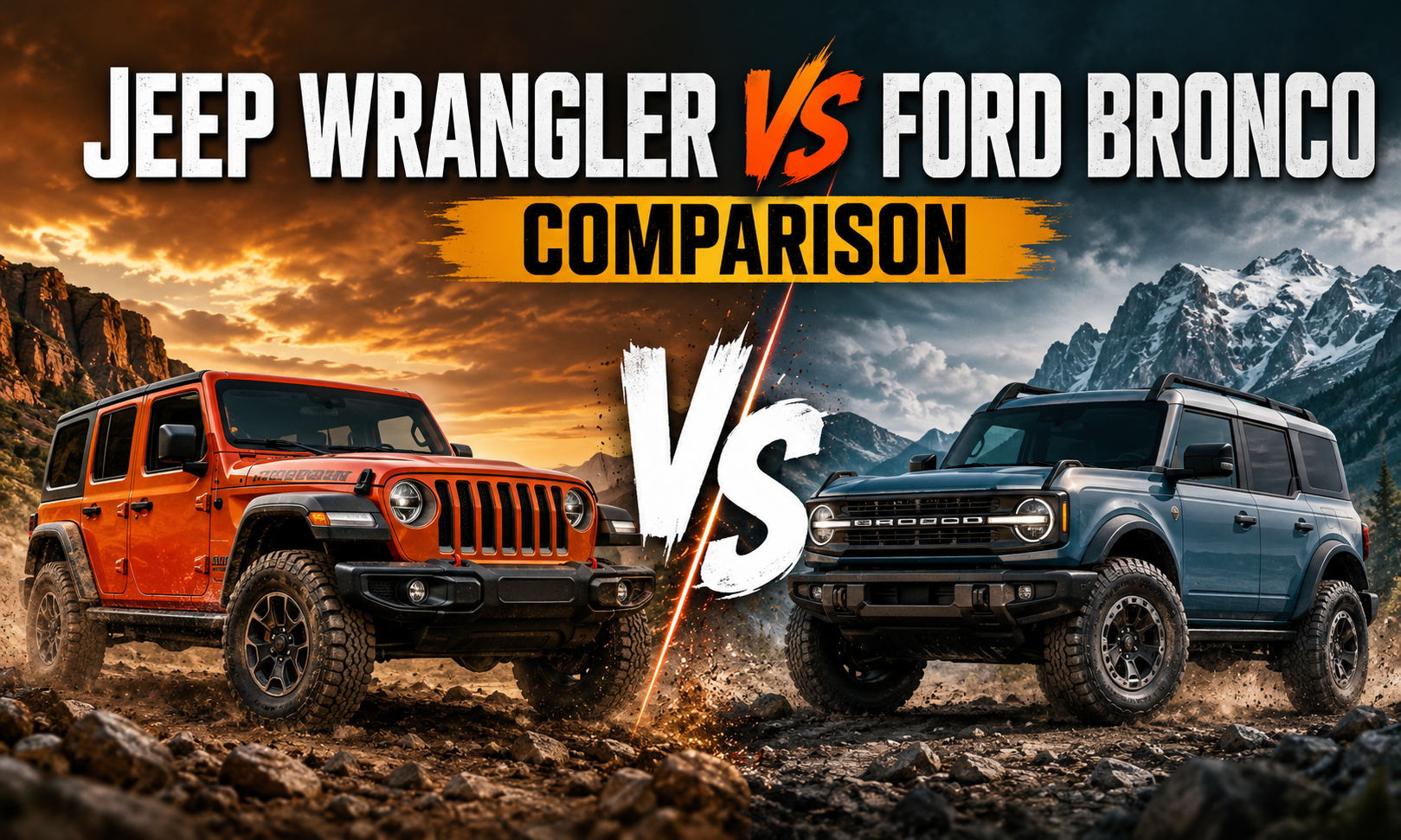
  • Jeep Wrangler vs Ford Bronco Comparison

    Jeep Wrangler vs Ford Bronco Comparison

    Which 4×4 Fits Your Real Life?

    A USA-focused guide that scores each SUV by commuting, trail type, passengers, towing, powertrain, and ownership cost.

    The jeep wrangler vs ford bronco comparison is easiest to settle when you stop asking which SUV is tougher and start asking which one matches the way you will use it 80 percent of the time. Both are body-on-frame 4x4s with removable roofs and doors, but the Ford Bronco generally feels more natural as a daily driver, while the Jeep Wrangler keeps a stronger advantage for slow technical trails, compact two-door maneuverability, and traditional solid-axle capability.

    THE 30-SECOND VERDICT

    Choose the Bronco for the broader mix of commuting, family travel, cargo, and moderate trail use. Choose the Wrangler when technical crawling, a shorter two-door body, the highest properly equipped four-door tow rating, or Jeep culture matters more than highway refinement.

    BEST FOR MOST MIXED-USE BUYERS
    FORD BRONCO
    More settled road manners, generous four-door cargo space, and strong high-speed dirt capability.
    BEST FOR TECHNICAL TRAIL PURISTS
    JEEP WRANGLER
    Solid axles, Rubicon hardware, a shorter two-door option, and a deep trail-focused ecosystem.
    BEST MAX TOW RATING
    WRANGLER 4-DOOR
    Up to 5,000 pounds when properly equipped, versus 3,500 for most Broncos and 4,500 for Raptor.
    2026 USA BUYER QUICK FACTS
    FACT FORD BRONCO JEEP WRANGLER
    Model year covered 2026 US-market lineup 2026 US-market lineup
    Body and seating 2-door or 4-door; seats 4 or 5 2-door or 4-door; seats 4 or 5
    Starting MSRP* $40,795 $36,035
    Main engine choices 2.3L turbo I4; 2.7L twin-turbo V6; 3.0L twin-turbo V6 2.0L turbo I4; 3.6L V6; 6.4L V8
    Maximum published output 418 hp and 440 lb-ft in Raptor 470 hp and 470 lb-ft in Wrangler 392
    Manual transmission Available with selected 2.3L models Available with selected 3.6L models
    Front suspension Independent HOSS system Solid front axle
    Rear suspension Solid five-link axle Solid rear axle
    Maximum tow rating 3,500 lb most models; 4,500 lb Raptor 2,000 lb 2-door; up to 5,000 lb certain 4-door configurations
    Representative 4-door cargo 35.6 cu ft behind row 2; 77.6 cu ft max with hardtop 31.7 cu ft behind row 2; 72.4 cu ft max in Sahara specification
    Center display 12-inch Available 12.3-inch
    Editorial best use Daily driving plus weekend adventure Technical trails plus traditional open-air 4×4 ownership

    *Starting MSRP excludes destination, taxes, registration, options, and dealer charges. Equipment and prices can change during the model year.

    The supplied Car and Driver 2026 comparison tool is useful for switching trims and reviewing baseline specifications. This guide takes a different route by translating those numbers into ownership decisions.

    Start With the 80 Percent Rule

    Most buyers do not spend every weekend on the Rubicon Trail or running desert whoops. They commute, carry groceries, load children or dogs, take highway trips, and occasionally use the capability they paid for. The right purchase should fit that normal pattern first and the rare adventure second.

    Use the table below as a starting point. It does not replace a test drive, and individual trims can reverse some advantages. A Bronco Base on modest tires behaves differently from a Bronco Raptor, just as a Wrangler Sport is a different machine from a Rubicon X or 392.

    YOUR REAL USE CASE START HERE WHY
    Daily commute plus weekend forest roads Ford Bronco The independent front suspension and broader cabin focus make it easier to live with during ordinary driving.
    Slow rock crawling and ledge work Jeep Wrangler Rubicon Solid axles, available front and rear lockers, sway-bar disconnect, and very low gearing favor controlled wheel placement.
    Family trips with camping gear Ford Bronco 4-door Its representative four-door cargo figures are larger and its road behavior is generally calmer.
    Small camper above 3,500 lb Wrangler 4-door, correctly configured Certain four-door Wranglers reach a 5,000-pound maximum. Verify the exact configuration before purchase.
    High-speed desert and washboard roads Ford Bronco The suspension layout and Raptor option are tuned toward speed, stability, and repeated impacts.
    Compact two-door trail vehicle Jeep Wrangler 2-door Its shorter overall length and 96.8-inch wheelbase make tight turns and breakover situations easier.
    V8 sound and acceleration Jeep Wrangler 392 The 470-hp V8 is unique in this matchup, but purchase price, fuel, tires, and insurance can be substantial.
    Comfortable stock 4×4 with occasional hard trails Ford Bronco Badlands It combines disconnecting front stabilizer-bar hardware with more everyday-friendly road manners.

    Why They Feel Different Before the Trail Starts

    The defining mechanical difference sits at the front axle. The Bronco uses independent front suspension, so one front wheel can react to a bump with less direct movement at the opposite wheel. That usually produces steadier steering on pavement, less head toss on broken roads, and more confidence on faster dirt.

    The Wrangler uses solid front and rear axles. Its front wheels are connected through one axle assembly, a layout valued for articulation, predictable geometry under load, and straightforward trail modifications. The tradeoff is that road impacts can be felt more directly through the steering and body, especially with aggressive tires or lifted suspension.

    Neither design wins every situation. The Bronco advantage grows as speed and highway mileage increase. The Wrangler advantage grows when a driver is moving slowly, placing tires precisely, crossing deep articulation points, or planning major aftermarket changes.

    HARDWARE AREA BRONCO WRANGLER BUYER IMPACT
    Front suspension Independent HOSS Solid axle Bronco for pavement and faster dirt; Wrangler for crawling and articulation
    Rear suspension Solid five-link axle Solid axle Both use durable truck-style rear layouts
    Steering feel Generally steadier and more carlike More active and trail-focused Bronco for long highway drives
    Tight-trail footprint 2-door wheelbase 100.4 in 2-door wheelbase 96.8 in Wrangler for switchbacks and compact trails
    Disconnect hardware Available on Badlands and selected advanced trims Electronic disconnect on Rubicon models Both can improve articulation when properly equipped
    Factory locker strategy Available front and rear depending on trim/package Available front and rear Tru-Lok on Rubicon Compare the exact window sticker, not just the model name

    Engine Choice Is About Character, Not Just Horsepower

    Both lineups range from sensible four-cylinder engines to expensive halo powertrains. The numbers matter, but delivery, transmission availability, fuel grade, tire size, axle ratio, and vehicle weight change the way each engine feels.

    POWERTRAIN OUTPUT TRANSMISSION BEST MATCH
    Bronco 2.3L turbo I4 300 hp / 325 lb-ft on premium fuel 7-speed manual or 10-speed automatic Value buyers, manual fans, and lighter builds
    Bronco 2.7L twin-turbo V6 330 hp / 415 lb-ft on premium fuel 10-speed automatic Loaded four-doors, hills, passing, and effortless torque
    Bronco Raptor 3.0L V6 418 hp / 440 lb-ft 10-speed automatic High-speed off-road use and halo performance
    Wrangler 2.0L turbo I4 270 hp / 295 lb-ft 8-speed automatic Strong low-rpm torque and mainstream ownership
    Wrangler 3.6L V6 285 hp / 260 lb-ft 6-speed manual or 8-speed automatic, depending on trim Traditional response, manual availability, and proven familiarity
    Wrangler 392 6.4L V8 470 hp / 470 lb-ft 8-speed automatic Sound, acceleration, and emotional appeal at a high operating cost

    The Smart Engine Picks

    For the Bronco, the 2.3-liter is not a consolation prize. It offers enough output for normal use and preserves the manual-transmission option on selected trims. The 2.7-liter V6 is the easier recommendation for buyers who routinely carry passengers, climb mountain grades, or simply prefer effortless midrange torque. Its main compromise is that it is automatic-only.

    For the Wrangler, the 3.6-liter V6 suits buyers who want a more linear response and the availability of a manual transmission. The 2.0-liter turbo makes more torque and pairs well with the automatic. The 392 is the emotional choice, not the rational value choice. Its speed and soundtrack are memorable, but fuel, insurance, brake, and tire costs deserve careful attention.

    FUEL NOTE Ford publishes the Bronco 2.3-liter and 2.7-liter peak ratings on premium fuel. They can operate on regular fuel, but published output is lower. Jeep states that its 2.0-liter and 3.6-liter engines can use 87-octane fuel, while premium can help the 2.0-liter achieve optimal performance.

    Off-Road Winner Depends on the Trail

    Calling one SUV the universal off-road winner oversimplifies the matchup. Tire type, tire pressure, driver skill, recovery gear, weather, and the exact package often matter more than the badge. The useful question is which platform gives you the better starting point for the terrain you actually visit.

    TERRAIN EDITORIAL ADVANTAGE REASON
    Slow rock gardens Jeep Wrangler Rubicon hardware, solid axles, and an available 100:1 crawl ratio support controlled, low-speed progress.
    Tight wooded trails Jeep Wrangler 2-door The shorter wheelbase and shorter body are easier to place around trees, switchbacks, and ledges.
    High-speed desert Ford Bronco Independent front suspension and advanced HOSS systems favor stability and impact control at speed.
    Washboard access roads Ford Bronco The front suspension generally filters repeated roughness more naturally.
    Mud and deep ruts Configuration dependent Tires, lockers, clearance, and momentum matter more than a simple model-level verdict.
    Snow plus dry pavement Configuration dependent Full-time 4×4 availability and winter tires can matter more than maximum trail angles.
    Moderate stock trails Ford Bronco by a small margin It delivers ample capability while demanding fewer compromises during the drive home.
    Extreme factory halo Different missions Bronco Raptor prioritizes speed and suspension travel; Wrangler Rubicon and 392 emphasize crawl hardware and character.
    TRAIL RULE Do not choose by maximum ground clearance alone. Wheelbase, breakover angle, tire diameter, differential position, approach and departure angles, underbody protection, and driver visibility determine whether that clearance is useful.

    Wrangler Rubicon vs Bronco Badlands

    For many serious shoppers, Rubicon versus Badlands is the comparison that matters. Both can be ordered with locking differentials, substantial underbody protection, large tires, low-range gearing, and disconnecting front stabilizer-bar hardware. The Wrangler still feels more purpose-built for crawling because its solid axles and available ultra-low crawl ratio support slow obstacle work. The Bronco Badlands is easier to recommend when the trip includes several hours of highway before the trail begins.

    A test drive should include the actual tire package you intend to buy. Thirty-five-inch tires can improve clearance and traction, but they also affect steering response, braking feel, noise, fuel use, replacement cost, and the height at which passengers must climb into the cabin.

    Daily Driving, Cabin, Cargo, and Technology

    The Bronco is usually the less demanding daily companion. Its steering tends to require fewer corrections, and the independent front suspension controls rough pavement with less side-to-side movement. The Wrangler has improved significantly over earlier generations, but it still feels more like a dedicated 4×4. Some buyers enjoy that constant sense of machinery; others find it tiring on long interstate trips.

    Four-door cargo space also favors the Bronco in representative manufacturer figures. A hardtop four-door Bronco lists 35.6 cubic feet behind the second row and 77.6 cubic feet with the rear seats folded. The soft-top figure can rise to 38.3 and 83.0 cubic feet. A four-door Wrangler Sahara specification lists 31.7 cubic feet behind the rear seat and 72.4 cubic feet maximum. Roof design, trim, and measuring method can affect usable space, so bring your real stroller, cooler, dog crate, or camping bins to the dealership.

    DAILY-LIFE AREA BRONCO WRANGLER ADVANTAGE
    Highway steering Generally calmer More active and trucklike Bronco
    Broken-road ride Better isolation in most trims More axle movement reaches the cabin Bronco
    Four-door cargo Larger representative figures Smaller but still practical Bronco
    Center screen 12-inch Available 12.3-inch Near tie
    Rear-seat use Good in four-door models Good in four-door models; manufacturer highlights rear room Test both
    Roof and wind noise Still noticeable, varies by top and tires Still noticeable, varies by top and tires Tie by configuration
    Trail visibility aids Available camera views and off-road displays Available trail guides and off-road pages Trim dependent
    Parking and garage fit Wider in aggressive packages Narrower in many configurations Wrangler for tight spaces

    Open-Air Experience: Different Kinds of Convenience

    Both SUVs let owners remove doors and roof panels, which is a major reason to buy either one. Jeep gives the Wrangler the deeper heritage and a vast community built around open-air ownership. For 2026, Jeep also added tool-free quick-release door hinges, reducing one of the traditional barriers to removing the doors.

    The Bronco answers with cowl-mounted side mirrors that remain in place when the doors come off. That small detail matters because it preserves factory mirror visibility without adding separate mirror hardware. Two-door Broncos use a standard hardtop, while four-door models use a standard soft top, with other roof combinations available.

    The Wrangler gets a slight editorial advantage for owners who value the ritual, tradition, and accessory ecosystem. The Bronco gets the convenience advantage for keeping its mirrors attached and for owners who want an open-air vehicle without making the experience the center of ownership.

    OPEN-AIR AREA BRONCO WRANGLER EDITORIAL TAKE
    Door removal Removable; mirrors stay on the cowl New tool-free quick-release hinges for 2026 Bronco for mirror convenience; Wrangler for faster tool-free removal
    Roof choices Hardtop, soft-top, and dual-top possibilities depending on body and trim Removable hardtops and soft tops, including multiple configurations Both
    Accessory culture Large and growing Exceptionally deep and established Wrangler
    Everyday open-air use Simple once panels and storage are understood Highly customizable but storage planning still matters Personal preference

    Towing and Utility: The Number on the Brochure Is Only Step One

    Most 2026 Bronco models are rated to tow up to 3,500 pounds when properly equipped. Bronco Raptor raises the maximum to 4,500 pounds. The Wrangler two-door is rated up to 2,000 pounds, while properly equipped four-door versions can reach 5,000 pounds. That gives the Wrangler the headline win, but only for the specific four-door configurations that carry the higher rating.

    Maximum trailer weight does not tell the whole story. Payload must cover passengers, cargo, accessories, and trailer tongue weight. Large tires, steel bumpers, winches, roof racks, and recovery gear can reduce the capacity left for people and luggage. Before signing, photograph the door-jamb payload label, confirm the axle ratio and tow package, and compare those numbers with the trailer manufacturer’s loaded weight, not its empty advertising figure.

    CONFIGURATION MAXIMUM PUBLISHED RATING WHAT TO VERIFY
    Bronco 2-door Up to 3,500 lb Requires correct tow equipment; confirm trim and package
    Bronco 4-door, most models Up to 3,500 lb Useful for light utility trailers and smaller campers
    Bronco Raptor Up to 4,500 lb Higher rating, but width, tire cost, and price are substantial
    Wrangler 2-door Up to 2,000 lb Short wheelbase and lower rating limit camper choices
    Wrangler 4-door Up to 5,000 lb when properly equipped Best maximum in this comparison; not every four-door reaches it

    Fuel, Insurance, Tires, and Real Ownership Cost

    Purchase price is only the first line of the budget. Both SUVs have upright bodies, exposed hardware, and available aggressive tires, so neither should be purchased as an efficiency play. Larger tires add rotating mass and aerodynamic drag, and replacement sets can cost much more than ordinary all-season tires. Lift kits and heavy accessories can further affect fuel use, alignment, braking, and warranty discussions.

    Fuel economy changes by engine, door count, axle ratio, tire package, and roof. Compare the exact configurations in the EPA side-by-side fuel economy tool, then estimate annual cost using the fuel grade and mileage pattern you will actually use.

    Insurance quotes can also vary sharply. A base two-door, a high-value Raptor, and a V8-powered Wrangler 392 are not treated the same. Get VIN-specific quotes before placing a deposit. Ask whether modifications, aftermarket wheels, winches, roof tents, or off-road use require additional coverage.

    COST AREA BRONCO WRANGLER EDITORIAL TAKE
    Entry price Higher starting MSRP Lower starting MSRP Wrangler
    Premium-fuel sensitivity Peak 2.3L and 2.7L output is published on premium 2.0L and 3.6L accept regular; premium helps 2.0L optimal performance Wrangler for fuel flexibility
    Large tire replacement High with Sasquatch; very high with Raptor High with Xtreme 35 and specialty trims Tie by tire size
    Insurance Can jump on Raptor and expensive packages Can jump on 392 and high-value builds Quote by VIN
    Accessory spending Large catalog and growing aftermarket Exceptionally broad aftermarket Wrangler offers more ways to overspend
    Daily comfort cost May reduce fatigue on long highway use More mechanical feel can be either charm or compromise Bronco for frequent road trips

    Best Trim Pairings to Test Back-to-Back

    Do not compare a luxury-oriented trim from one brand with a stripped trail trim from the other and call the result fair. Start with comparable missions, then match engine, door count, tire size, roof type, and key off-road hardware as closely as possible.

    BUYING MISSION BRONCO TO DRIVE WRANGLER TO DRIVE WHAT TO NOTICE
    Value and open-air access Bronco Base Wrangler Sport or Sport S Wrangler starts lower; Bronco brings more road-friendly architecture
    Comfort plus weekend trails Bronco Outer Banks Wrangler Sahara Focus on seat comfort, top noise, cameras, and tire package
    Technical off-road core Bronco Badlands Wrangler Rubicon The most meaningful enthusiast comparison for many buyers
    Factory 35-inch tires Bronco with Sasquatch Package Wrangler with Xtreme 35 package Compare step-in height, braking, noise, and replacement cost
    Halo performance Bronco Raptor Wrangler 392 Raptor favors high-speed terrain; 392 favors V8 character and Jeep feel

    A 20-Minute Test-Drive Checklist

    1. Drive at 65 to 75 mph and note how often you make small steering corrections. Include a rough highway section if possible.
    2. Cross a patched road or diagonal driveway slowly. Notice head toss, axle movement, and how the steering reacts.
    3. Sit in the rear seat behind your own driving position. Check knee room, foot space, seatback angle, and the climb through the rear door.
    4. Load the cargo area with something you actually carry. Test the swing gate, roof height, rear-seat folding, and access in a tight parking space.
    5. Use the touchscreen with gloves or wet hands. Find the camera views, drive modes, locker controls, climate settings, and smartphone functions without coaching.
    6. Ask the salesperson to explain the exact four-wheel-drive system. Confirm whether it has full-time operation, lockers, stabilizer-bar disconnect, and the axle ratio you expect.
    7. Listen at highway speed with the roof installed. Tire choice and roof type can change cabin noise more than the trim badge.
    8. Check garage width and height, including mirrors, roof rack, larger tires, and any planned lift.
    9. Photograph the window sticker and door-jamb payload label. Compare them with the online configurator after the drive.
    10. Price a replacement set of the exact tires, a full insurance policy, and the first accessories you plan to add before deciding what you can afford.

    Final Category Scorecard

    The scorecard below is an editorial buying aid, not a laboratory test result. It assumes comparable 2026 configurations and gives extra weight to the way most owners use these SUVs in the United States.

    CATEGORY EDITORIAL WINNER WHY
    Highway ride and steering Ford Bronco Independent front suspension and calmer tracking
    Technical rock crawling Jeep Wrangler Solid axles, Rubicon hardware, and very low available crawl gearing
    High-speed off-road terrain Ford Bronco HOSS suspension range and Raptor specialization
    Four-door cargo utility Ford Bronco Larger representative cargo figures
    Open-air heritage and ecosystem Jeep Wrangler Long-established owner culture and aftermarket
    Door-off mirror convenience Ford Bronco Cowl-mounted mirrors remain with the vehicle
    Maximum towing Jeep Wrangler 4-door Up to 5,000 pounds when properly equipped
    Lowest starting price Jeep Wrangler Lower 2026 starting MSRP before destination
    Manual-transmission availability Tie Both offer manuals in selected configurations
    Best for most mixed-use owners Ford Bronco by a small margin Better daily balance without giving up serious trail capability

    Frequently Asked Questions

    Which is better overall, the Jeep Wrangler or Ford Bronco?

    The Bronco is the better all-around choice for many buyers because it balances commuting, cargo, highway travel, and trail use. The Wrangler is the better choice for drivers who prioritize technical crawling, compact two-door maneuverability, traditional solid-axle behavior, and Jeep culture.

    Which one is better off-road?

    It depends on terrain and configuration. Wrangler Rubicon has the edge on slow technical rocks. Bronco has an advantage on faster desert terrain and rough access roads. Tires, lockers, recovery equipment, and driver skill can change the result.

    Which rides better on the highway?

    The Ford Bronco generally rides and tracks more naturally on the highway because of its independent front suspension. The Wrangler feels more mechanical and may require more steering correction, especially with large off-road tires.

    Which is better for rock crawling?

    A properly equipped Wrangler Rubicon is the stronger factory starting point for dedicated rock crawling. Its solid axles, electronic sway-bar disconnect, available front and rear lockers, and low crawl gearing support controlled obstacle work.

    Which has more cargo space?

    Representative four-door figures favor the Bronco. A hardtop four-door Bronco lists 35.6 cubic feet behind the second row and 77.6 cubic feet maximum, while a four-door Wrangler Sahara lists 31.7 and 72.4 cubic feet.

    Which can tow more?

    A properly equipped four-door Wrangler can tow up to 5,000 pounds. Most Broncos are rated up to 3,500 pounds, while Bronco Raptor reaches 4,500 pounds. The exact tow package, axle ratio, payload, and VIN-specific rating must be confirmed.

    Which one is cheaper?

    The 2026 Wrangler has the lower starting MSRP, but equipped prices overlap quickly. Tire packages, hardtops, advanced off-road hardware, luxury features, and high-output engines can add tens of thousands of dollars to either vehicle.

    Can the doors and roof be removed on both?

    Yes. Both offer removable doors and roof configurations. The Bronco keeps its side mirrors mounted to the cowl when the doors are removed. The 2026 Wrangler adds tool-free quick-release door hinges.

    Do both offer a manual transmission?

    Yes, but only with selected engines and trims. The Bronco manual is tied to the 2.3-liter engine on eligible models. The Wrangler manual is associated with selected 3.6-liter V6 configurations.

    Which is easier to use as a daily driver?

    The Bronco is easier for most people to daily drive because of its steering, ride, cargo packaging, and higher-speed stability. A Wrangler can still be a satisfying daily vehicle for an owner who accepts its more specialized character.

    Final Verdict

    The final jeep wrangler vs ford bronco comparison comes down to how much specialization you are willing to live with every day. The Ford Bronco is the stronger default recommendation for US buyers who commute, carry family or gear, take highway trips, and explore moderate to difficult trails on weekends. The Jeep Wrangler is the more compelling choice when slow technical off-roading, a truly compact two-door, the highest properly equipped four-door tow rating, a V8 option, or the Jeep open-air community sits at the center of the purchase. Test comparable trims on comparable tires, verify the exact drivetrain and payload labels, and buy for the 80 percent of driving you will actually do.

    BUY THE FORD BRONCO WHEN… BUY THE JEEP WRANGLER WHEN…
    You drive more highway miles than trail miles; want the calmer daily experience; need strong four-door cargo space; prefer high-speed dirt performance; or value door-off mirrors that stay in place. You prioritize crawling and articulation; want the shortest two-door footprint; need an available 5,000-pound four-door tow rating; prefer the Jeep ecosystem; or want the unique 392 V8 experience.