 By
By 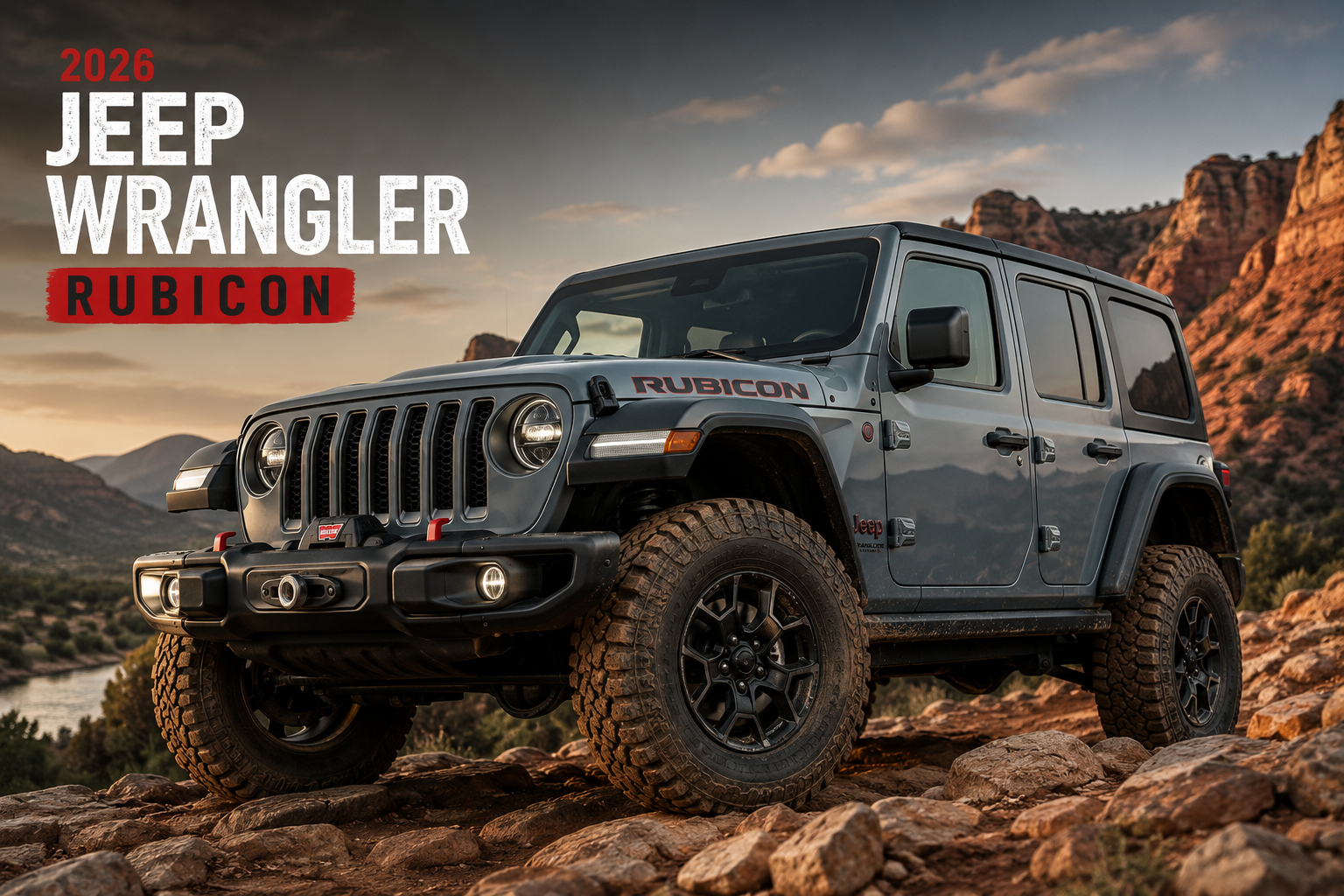
A trail-first guide to what the Rubicon gives you, what it asks you to tolerate, and which configuration makes sense.
Many SUVs are designed to look adventurous. The Wrangler Rubicon is built for owners who may actually cross ruts, climb rocks, or remove the roof for a weekend trip. That purpose shapes its solid axles, tall body, steering, cabin, and cargo compromises.
The 2026 Jeep Wrangler Rubicon is therefore best understood as specialized equipment that can also serve as daily transportation. It is not the quietest, smoothest, or most efficient SUV near $50,000, but few factory vehicles provide the same combination of locking differentials, low-range gearing, suspension articulation, removable body panels, and aftermarket support.
| KEY TAKEAWAYS
· Rubicon starts at $45,815 before the $1,995 destination fee, or about $47,810 delivered before taxes and options. · Engine choices are a 285-hp V6 with manual or automatic, or a 270-hp turbo four with automatic. · Key hardware includes 4:1 low range, front and rear lockers, sway-bar disconnect, rock rails, and 33-inch tires. · Choose two-door for tighter trails, four-door for passengers, cargo, highway stability, and higher towing. |
Start With the Hardware, Not the Horsepower
The Rubicon badge changes more than the styling. Instead of relying mainly on electronic traction aids, it uses heavy-duty axles, mechanical lockers, a dedicated low-range transfer case, and a disconnecting front sway bar. These components help keep the tires engaged and deliver torque when the ground becomes uneven.
Jeep explains that the electronic sway-bar disconnect allows the front wheels to drop and compress more freely on difficult terrain, while rock rails help protect the body. The official Wrangler capability overview also identifies the Rubicon as the model aimed at the toughest factory-supported trails.
Rubicon Trail-Hardware Decoder
| Hardware | Function | Buyer Benefit |
| 4:1 low range | Multiplies torque at low speed | Better control on steep or rocky terrain |
| Front and rear lockers | Turns both wheels on an axle together | Maintains traction when a tire lifts |
| Sway-bar disconnect | Increases front-wheel articulation | Keeps tires planted on uneven ground |
| 33-inch tires | Adds grip and clearance | Trail-ready without an immediate tire swap |
| Rock rails | Protects lower body sides | Reduces damage on ledges |
| Solid axles | Supports articulation and durability | Excellent off-road, less refined on-road |
2026 Pricing: The Number on the Window Sticker
Jeep lists the Rubicon at a base MSRP of $45,815. Adding the $1,995 destination charge produces a starting figure of $47,810 before tax, registration, accessories, or options. A four-door body, automatic transmission, hardtop, safety packages, upgraded audio, and steel bumpers can quickly move the price above $50,000.
The reference review from Car and Driver places the Rubicon in the middle of the wider Wrangler range and emphasizes the same central tradeoff: exceptional off-road identity paired with trucklike road manners. That is a useful warning for shoppers who are comparing it only by price with smoother midsize SUVs.
Rubicon X starts at $55,765 before destination, or about $57,760 after destination. The extra cost buys richer materials, power seating, premium glass, body-color details, and additional factory equipment. It improves convenience, but it does not fundamentally change the Wrangler’s driving character.
Rubicon vs. Rubicon X
| Category | Rubicon | Rubicon X |
| Base MSRP | $45,815 | $55,765 |
| Trail hardware | Complete Rubicon package | Same core capability |
| Cabin | Durable and functional | More premium and convenient |
| Best for | Value or custom builds | Loaded factory build |
| Main concern | Options raise price quickly | Large price premium |
Which Engine Fits the Rubicon Best?
3.6-Liter Pentastar V6
The 3.6-liter V6 produces 285 horsepower and 260 pound-feet of torque. It can be paired with a six-speed manual or an eight-speed automatic. The manual suits traditionalists who want maximum involvement, while the automatic is easier in traffic and during slow technical driving.
2.0-Liter Turbocharged Four-Cylinder
The turbo four produces 270 horsepower and 295 pound-feet of torque and comes only with the eight-speed automatic. Its low-speed torque makes the Wrangler feel responsive in normal driving and on moderate climbs. Buyers who value familiar, naturally aspirated response may still prefer the V6.
Neither engine turns the regular Rubicon into a performance SUV. Acceleration is adequate, but its tires, gearing, upright shape, and steering favor trail control over speed. V8-powered 392 editions are far quicker, but they bring a much higher purchase price and fuel bill.
What the Rubicon Feels Like in Three Real Environments
1. Technical Trail
This is where the Rubicon earns its price. Low range allows controlled movement, the lockers preserve traction when tires unload, and the sway-bar disconnect increases articulation. The upright body helps the driver judge the vehicle’s corners, while the two-door’s shorter wheelbase is useful over sharp crests.
2. Highway Commute
At highway speed, the Rubicon needs more steering correction than a car-based SUV. Tire noise, wind noise, and crosswind sensitivity are more noticeable. The four-door rides more calmly than the two-door, but neither feels as settled as a conventional midsize SUV.
3. City and Weekend Use
Forward visibility is excellent and the upright dimensions are easy to place in traffic. The rear gate needs space to swing open, and the two-door’s back seat is inconvenient. Open-air driving remains a major advantage, with soft-top, hardtop, and available Sky One-Touch configurations.
Shoppers who are cross-shopping trail-focused vehicles should also review a practical Jeep Wrangler vs. Ford Bronco comparison. The Bronco often feels more stable and modern on pavement, while the Wrangler preserves the simpler removable-body experience and has an enormous accessory ecosystem.
Two-Door or Four-Door?
The two-door is the classic and more agile trail choice. It turns more easily between obstacles and has a better breakover angle. Its disadvantages are limited cargo room, difficult rear-seat access, a busier highway ride, and a 2,000-pound tow rating.
The four-door Wrangler Unlimited is the practical choice for most US households. It provides easier passenger access, more cargo space, calmer highway behavior, and a tow rating of up to 3,500 pounds when properly configured. The longer wheelbase is less ideal over sharp crests, but daily usability improves substantially.
Body-Style Decision Table
| Use Case | Two-Door | Four-Door |
| Tight trails | Best choice | Less nimble |
| Rear passengers | Occasional | Much easier |
| Cargo | Limited | More useful |
| Highway ride | Busier | Calmer |
| Towing | Up to 2,000 lb | Up to 3,500 lb |
| Character | Classic | More practical |
Interior and Technology: Better, Still Purposeful
A 12.3-inch Uconnect 5 touchscreen is standard, with wireless Apple CarPlay and Android Auto. Physical controls remain for climate, windows, and off-road systems, which is useful on rough ground. Available trail mapping can display thousands of mapped routes through a subscription service.
The upright dashboard and close windshield preserve the traditional Wrangler feel. Durable materials suit outdoor use. Rubicon X can make the cabin more premium, but neither trim offers the quietness or finish of a conventional luxury SUV at a similar price.
Fuel, Tires, and Ownership Costs
Ownership costs go beyond the payment. Gas Rubicons generally return fuel economy in the high teens, depending on body style, engine, tires, roof, speed, and accessories. All-terrain tires cost more than ordinary crossover tires, while lifts, armor, winches, and roof equipment can add weight and reduce efficiency.
Jeep provides a three-year or 36,000-mile basic warranty, a five-year or 60,000-mile powertrain warranty, and two complimentary maintenance visits. Before modifying the vehicle, confirm how the change may affect alignment, safety-system calibration, insurance, warranty coverage, and state regulations.
A broader best off-road SUVs guide can help buyers decide whether they truly need locking differentials and removable doors or would be happier with a quieter vehicle that still handles snow, dirt roads, and moderate trails.
Who Should Buy a 2026 Wrangler Rubicon?
The regular Rubicon suits buyers who will use the hardware, enjoy mechanical character, or want a factory base for later modifications. It also appeals to owners who value removable panels, open-air driving, and the Jeep community as much as comfort or fuel economy.
It is harder to recommend to shoppers who rarely leave pavement or expect luxury-SUV refinement. A Sport, Willys, or a different midsize SUV may meet those needs for less money. Rubicon X makes sense for buyers who want premium features and factory-installed accessories.
Final Verdict
The 2026 Jeep Wrangler Rubicon asks owners to accept wind noise, modest efficiency, imperfect steering, and limited cargo space in exchange for serious trail ability and a removable, highly customizable body. That tradeoff is either the reason to buy it or the reason to choose something else.
For most enthusiasts, the four-door Rubicon with either gas engine and a restrained option list is the sweet spot. The two-door is the purer trail tool, while Rubicon X is best viewed as a premium convenience package.
Frequently Asked Questions
How much does a 2026 Jeep Wrangler Rubicon cost?
The two-door Rubicon starts at $45,815 before destination. Adding Jeep’s $1,995 destination charge brings the starting figure to approximately $47,810 before taxes, registration, options, or dealer fees.
Does the 2026 Wrangler Rubicon come with a manual transmission?
Yes. The 3.6-liter V6 can be paired with a six-speed manual transmission. The turbocharged 2.0-liter four-cylinder is paired with an eight-speed automatic.
Is Rubicon X more capable than Rubicon?
Rubicon X adds premium equipment, but the standard Rubicon already includes the essential low range, lockers, sway-bar disconnect, rock rails, and off-road tires. Choose Rubicon X mainly for comfort and factory options.
Can the Rubicon be used as a daily driver?
Yes, especially in four-door form. Buyers should test it at highway speed before purchasing because steering, noise, ride quality, and fuel consumption differ noticeably from a car-based SUV.
How much can the Wrangler Rubicon tow?
The two-door Rubicon can tow up to 2,000 pounds. Properly configured four-door models can tow up to 3,500 pounds. Verify the exact vehicle’s equipment, hitch rating, door label, and owner’s manual before towing.


Comments