
 By
By 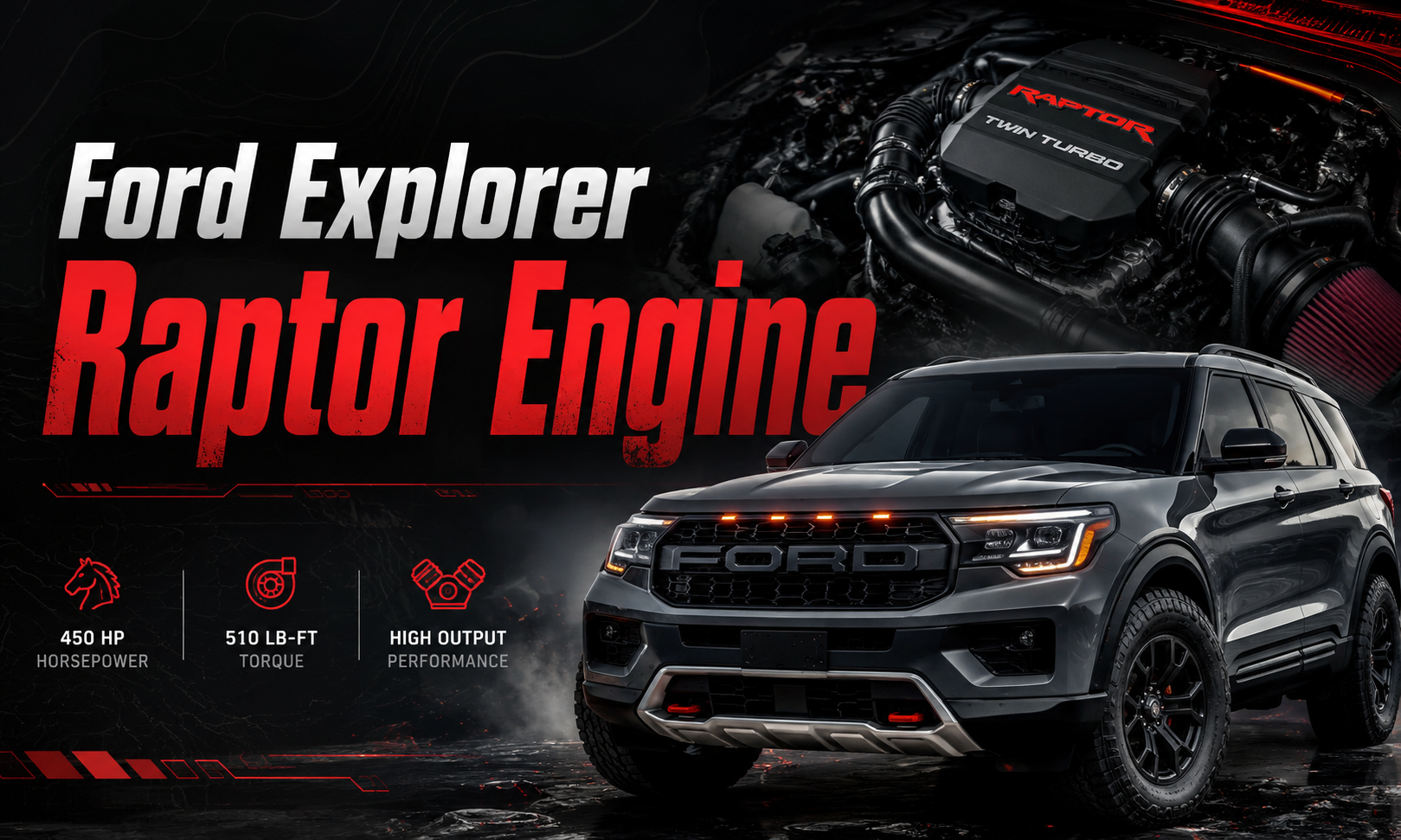
A technical look at the engine Ford already has, the power targets that make sense, and why an Explorer Raptor remains speculation rather than a confirmed model.
| CURRENT STATUS
Not announced |
MOST PLAUSIBLE ENGINE
3.0L EcoBoost V6 |
REALISTIC OUTPUT
About 400 to 430 hp |
The ford explorer raptor engine does not exist as a factory specification because Ford has not announced an Explorer Raptor. However, the engineering answer is less mysterious than the name suggests. The current Explorer already uses a twin-turbocharged 3.0-liter EcoBoost V6, a 10-speed automatic transmission, and a rear-wheel-drive-based platform with available four-wheel drive. That makes a higher-output version of the existing V6 the most realistic foundation for any future Raptor-branded Explorer.
The important distinction is that an engine alone would not create a Raptor. Ford would also need to redesign the cooling system, suspension, steering, underbody protection, wheel travel, brakes, tires, and electronic drive modes. A simple badge change or horsepower tune would be closer to an Explorer ST performance package than a genuine high-speed off-road model.
| 30-second answer
Ford has not confirmed an Explorer Raptor. If one were approved, the most credible powertrain would be a specially calibrated 3.0-liter twin-turbo EcoBoost V6 producing roughly 400 to 430 horsepower and about 430 to 450 pound-feet of torque. A 3.5-liter Raptor V6 or supercharged V8 would be far less likely because of packaging, cooling, cost, weight, and emissions challenges. |
Explorer Raptor Quick Facts
| Item | Current assessment |
| Official model status | No Ford Explorer Raptor has been announced as of July 2026 |
| Closest current model | Explorer Tremor for off-road use; Explorer ST for road performance |
| Most plausible engine | 3.0-liter twin-turbocharged EcoBoost V6 |
| Current Explorer V6 output | Ford lists 385 hp and 415 lb-ft for the 2026 model; some independent specifications list 400 hp |
| Likely Raptor target | Approximately 400 to 430 hp and 430 to 450 lb-ft, editorial estimate |
| Transmission | Heavy-duty calibration of Ford 10-speed automatic |
| Drivetrain requirement | Standard performance-oriented four-wheel drive with stronger cooling and torque management |
| Expected positioning | Three-row, high-speed adventure SUV above Tremor and beside ST |
| Likely price range | $65,000 to $75,000 before options, editorial estimate |
| Main obstacle | Turning a family crossover into a durable Raptor without damaging ride comfort and cabin practicality |
Is a Ford Explorer Raptor Real?
No. Ford currently sells the Explorer in road-focused, luxury-oriented, and trail-oriented forms, but Raptor is not part of the official Explorer lineup. Online renderings, social posts, speculative videos, and dealer-style graphics should not be treated as production confirmation. The actual off-road-focused model is the Explorer Tremor, while the ST remains the quickest and most performance-oriented road version.
The supplied Car and Driver Explorer review and specifications page lists the current engine family, performance data, towing capacity, fuel economy, and trim structure. It identifies a 300-hp 2.3-liter turbocharged four-cylinder and a twin-turbocharged 3.0-liter V6 for higher-performance configurations, but it does not identify a factory Explorer Raptor model.
That absence matters for SEO content. An accurate article should answer the search query without presenting speculation as a launch announcement. Readers may be searching for a rumored model, a rendering, an engine swap, or simply the most powerful off-road Explorer. The article therefore needs to explain both the current lineup and the engineering path Ford could follow.
The Explorer Engine Ladder Today
The current Explorer offers two EcoBoost engine families. The smaller engine supports mainstream trims, while the 3.0-liter V6 gives Ford a ready-made performance base.
| Engine | Configuration | Reported output | Torque | Transmission | Best fit |
| 2.3L EcoBoost | Turbo I-4 | 300 hp | 310 lb-ft | 10-speed automatic | Active, ST-Line, Platinum, base Tremor |
| 3.0L EcoBoost | Twin-turbo V6 | 385 to 400 hp* | 415 lb-ft | 10-speed automatic | ST and optional Tremor |
*The output varies by source and model-year presentation. Ford’s current US consumer page lists 385 horsepower, while Car and Driver lists 400 horsepower and notes that power figures depend on premium fuel.
For a theoretical Raptor, the four-cylinder is not a serious candidate. It can move the Explorer efficiently and provides useful torque for ordinary driving, but a Raptor badge requires stronger acceleration, sustained high-load durability, and sufficient reserve power for larger tires and additional chassis weight. The existing V6 is the practical starting point because Ford already packages it in the Explorer body and pairs it with the same basic transmission family.
Ford’s official 2026 Explorer performance and engine page currently lists 300 horsepower and 310 pound-feet for the 2.3-liter EcoBoost, plus 385 horsepower and 415 pound-feet for the 3.0-liter EcoBoost V6. It also confirms a 5,000-pound maximum towing capacity, six available drive modes depending on trim, and standard or available four-wheel drive configurations.
Which Engine Would Make the Most Sense?
Four powertrain paths are technically imaginable, but only one fits the Explorer with limited redevelopment. The table below ranks each choice by engineering practicality rather than excitement.
| Candidate | Possible output | Packaging fit | Cost impact | Raptor credibility | Verdict |
| Explorer 3.0L EcoBoost V6, retuned | 400 to 430 hp | Excellent | Moderate | High with full chassis upgrade | Most realistic |
| Bronco Raptor-style 3.0L calibration | Up to about 418 hp | Very good | Moderate | High | Strong possibility |
| F-150 Raptor 3.5L EcoBoost V6 | Around 450 hp | Uncertain | High | Very high | Possible but unlikely |
| F-150 Raptor R 5.2L supercharged V8 | Far above 700 hp | Poor | Extreme | Dramatic but impractical | Not credible |
| Performance hybrid V6 | 450 hp or more | Complex | Very high | Depends on durability | Long-term possibility |
1. Retuned 3.0-Liter EcoBoost V6
This is the clear engineering favorite. The block, engine mounts, transmission relationship, electronics, exhaust routing, and basic thermal packaging already exist in the Explorer. Ford could raise output through revised turbocharger control, airflow, fueling, exhaust tuning, and software, then add the cooling hardware required for repeated use in hot, dusty conditions.
A modest increase to roughly 410 or 420 horsepower would be enough if the vehicle also gained shorter gearing, faster torque delivery, and a lighter wheel-and-tire package. Raptor performance is not only about peak output. Response, heat management, traction, and suspension speed matter more than a headline horsepower number when a heavy three-row SUV is crossing broken terrain.
2. Bronco Raptor-Style 3.0-Liter Tune
The Bronco Raptor demonstrates that Ford can produce 418 horsepower and 440 pound-feet from a 3.0-liter EcoBoost V6. That output range is almost ideal for a hypothetical Explorer version because it would create a visible step above the current V6 without demanding a completely different engine family.
Even so, Ford could not simply copy the Bronco calibration. The Explorer has different airflow, exhaust packaging, curb weight, cooling paths, axle hardware, duty cycle, and customer expectations. A family SUV may spend more time towing, idling in traffic, and carrying passengers than a Bronco Raptor. Ford would need to validate the tune for quieter operation, emissions compliance, and sustained cabin comfort.
3. High-Output 3.5-Liter EcoBoost V6
The 450-hp, 510-lb-ft engine used in the F-150 Raptor would give an Explorer extraordinary straight-line performance. It would also create major questions about front-end packaging, crash structure, cooling capacity, transmission durability, axle strength, fuel consumption, and weight distribution. A larger engine could force so many surrounding changes that the business case would become difficult for a relatively low-volume SUV trim.
4. Supercharged V8
A supercharged V8 would attract attention but makes little product sense. The Explorer was not designed around the Raptor R powertrain, and the cost of adapting the engine, cooling system, transmission, driveline, brakes, and crash structure would be enormous. It would also undermine fuel-economy and emissions targets while pushing the price into territory occupied by larger luxury performance SUVs.
5. Performance Hybrid
A future hybrid system could combine a V6 with electric assistance to improve low-speed torque and fill turbo lag. That approach could deliver impressive acceleration, but battery protection, cooling, weight, water exposure, and underbody packaging would be difficult in a vehicle intended for rough terrain. A hybrid Raptor-like Explorer is more believable on a next-generation platform than as a near-term derivative of the current model.
For searchers asking specifically about the ford explorer raptor engine, the most responsible conclusion is a projected 3.0-liter twin-turbo EcoBoost V6, not a V8. A reasonable editorial target is 400 to 430 horsepower and 430 to 450 pound-feet of torque, paired with a strengthened 10-speed automatic and standard performance four-wheel drive. Those numbers are estimates, not leaked or confirmed specifications.
Why More Power Would Not Be Enough
Ford uses the Raptor name for vehicles designed around high-speed off-road control and durability. An Explorer version would need a full engineering program, not only a stronger engine tune.
| System | Current Explorer baseline | Raptor-level requirement | Why it matters |
| Cooling | Road and light-trail duty | Larger radiators, charge cooling, transmission and differential cooling | Prevents power reduction during heat and repeated high-load use |
| Suspension | ST road tune or Tremor trail tune | Longer travel, remote-reservoir or adaptive dampers, reinforced mounts | Controls body motion and wheel impacts at speed |
| Track width | Family SUV proportions | Wider stance and stronger hubs | Improves stability with larger tires and suspension travel |
| Tires | Street or moderate all-terrain choices | Purpose-built all-terrain tires | Adds grip and impact resistance but increases weight and drag |
| Brakes | Strong road-oriented hardware | More thermal capacity and off-road calibration | Manages higher speed and heavier wheel packages |
| Underbody | Tremor skid protection | More complete protection for engine, transmission, fuel, and driveline | Reduces damage risk on repeated rough-surface use |
| Software | Sport, Trail, or Off-Road modes by trim | Baja-style mode, launch logic, revised stability control | Coordinates throttle, shifting, damping, steering, and torque distribution |
Cooling Would Decide the Real Horsepower
A dyno number is easy to advertise. Repeating that output in a loaded SUV on a hot desert trail is much harder. Larger charge-air coolers, better radiator airflow, protected transmission cooling, differential cooling, and carefully managed underhood pressure would determine whether the engine could sustain performance. Ford might deliberately cap peak output below another Raptor model to preserve durability.
The 10-Speed Automatic Would Need New Calibration
The existing 10-speed automatic is the logical transmission, but shift programming would need to change. Off-road use demands rapid downshifts, controlled engine braking, predictable throttle response, and fewer unnecessary gear changes on loose surfaces. Ford could also strengthen cooling, clutch capacity, and torque management rather than replacing the transmission entirely.
Four-Wheel Drive Would Be Standard
Rear-wheel drive is useful for the standard Explorer’s pricing and fuel economy, but a Raptor version would almost certainly use standard four-wheel drive. The system would need aggressive torque distribution, stronger half-shafts, protected driveline components, and calibration that permits controlled wheelspin without overwhelming the hardware.
Explorer ST, Tremor, and Hypothetical Raptor
The clearest way to understand the missing Raptor is to separate three different jobs. ST is the road-performance model. Tremor is the practical trail model. A Raptor would need to combine family utility with far more specialized high-speed off-road hardware.
| Category | Explorer ST | Explorer Tremor | Hypothetical Raptor | Best choice today |
| Main purpose | Fast road driving | Moderate trail use | High-speed rough-terrain performance | Depends on use |
| Engine focus | Maximum current acceleration | Choice of efficiency or V6 power | Sustained power with extreme cooling | ST for speed |
| Suspension | Firm, road-oriented | Lifted and off-road-tuned | Long-travel, high-capacity dampers | Tremor for trails |
| Tires | Performance street tires | All-terrain tires | Larger Raptor-specific all-terrain tires | Tremor off pavement |
| Ride and noise | Sporty and firm | Balanced | Likely louder and less efficient | Tremor for mixed use |
| Official availability | Yes | Yes | No | ST or Tremor |
| Closest thing buyers can purchase now
Choose the Explorer ST when acceleration, road handling, and sporty styling matter most. Choose the Explorer Tremor when ground clearance, all-terrain tires, underbody protection, and trail traction matter more. Adding the available V6 to the Tremor creates the closest current combination of power and off-road equipment, but it is still not a Raptor. |
||||
Estimated Performance If Ford Built One
The following figures are scenario estimates based on current Explorer hardware and Ford’s existing Raptor powertrains. They are not official specifications or insider information.
| Metric | Conservative scenario | Aggressive scenario | Editorial expectation |
| Engine output | 400 hp / 430 lb-ft | 430 hp / 450 lb-ft | About 418 hp |
| 0 to 60 mph | About 5.2 seconds | About 4.8 seconds | Near 5.0 seconds |
| Towing capacity | 5,000 lb | 5,000 lb | Likely unchanged |
| Ground clearance | About 9.0 inches | 9.5 inches or more | Around 9.2 inches |
| Tire size | 32-inch class | 33-inch class | Likely 32 to 33 inches |
| EPA combined economy | About 19 mpg | About 17 mpg | Likely 17 to 19 mpg |
| Starting price | $64,000 | $75,000 | About $69,000 |
A faster 0-to-60 time would not necessarily be Ford’s main target. Large all-terrain tires, raised suspension, skid plates, and reinforced components add rotating and total mass. Ford could accept slightly slower acceleration than the ST in exchange for better heat control, off-road stability, and impact durability.
Would an Explorer Raptor Make Business Sense?
The idea has obvious appeal. A three-row Raptor could serve buyers who want more passenger space than a Bronco Raptor and a smaller footprint than an F-150 Raptor or Expedition. It could also give Ford a distinctive answer to off-road-themed three-row SUVs that currently focus more on trail access than desert speed.
The challenge is overlap. The Explorer already offers the ST and Tremor, while Ford also sells the Bronco Raptor, Ranger Raptor, F-150 Raptor, and larger adventure-oriented SUVs. A new model would need enough capability to justify the Raptor name without stealing too many buyers from those existing products. It would also need to remain useful as a three-row family vehicle, which limits tire size, suspension travel, width, ride firmness, and cargo compromises.
| Reasons Ford could build it | Reasons Ford may avoid it |
| • Existing 3.0L V6 reduces engine-development cost | • Significant suspension, cooling, and body changes would be expensive |
| • Three-row Raptor would occupy a rare market position | • Could overlap Bronco Raptor and larger Ford adventure models |
| • Strong demand for premium off-road appearance and capability | • Wider body and aggressive tires reduce family convenience |
| • Tremor creates a lower step in the product ladder | • Fuel economy and emissions become harder to manage |
| • High-margin trim could strengthen Explorer identity | • Low production volume may not repay engineering investment |
What Should Buyers Do Now?
- Do not place a deposit based only on a rendering, social post, or unofficial dealer page. Confirm that a model appears on Ford’s official US website or in a formal company announcement.
- Test-drive the Explorer ST if engine performance is the priority. Its V6 and road tuning are more relevant than Raptor speculation for buyers who remain on pavement.
- Test-drive the Explorer Tremor if off-road equipment matters. Consider the available V6 when you want the strongest current mix of power, traction, and trail hardware.
- Compare total ownership costs. Larger all-terrain tires, premium fuel, higher insurance, and lower fuel economy can add meaningful annual expense.
- Wait for verified specifications before comparing price or capability. A true Raptor would likely cost substantially more than a Tremor or ST once options are included.
Claim Checker
| Claim | Assessment | Reason |
| Ford has confirmed an Explorer Raptor | False | No official production model has been announced |
| It will use a V8 | Unsupported | The existing 3.0L V6 is a far more practical fit |
| The Explorer already offers Raptor-level power | Partly true | Current V6 output is strong, but Raptor hardware involves much more than horsepower |
| Tremor is the Explorer Raptor | False | Tremor is a separate, less extreme off-road tier |
| A 3.0L EcoBoost is the likely engine | Reasonable speculation | The Explorer already packages that engine and Ford tunes it higher in other applications |
| A future model would keep three rows | Likely | Removing the third row would weaken the Explorer’s purpose and market position |
Frequently Asked Questions
Does Ford make an Explorer Raptor?
No. Ford has not announced or sold a factory Explorer Raptor in the United States as of July 2026. The official off-road-oriented trim is the Explorer Tremor.
What engine would an Explorer Raptor probably use?
The most plausible choice is a higher-output version of the 3.0-liter twin-turbo EcoBoost V6 already used in the Explorer ST and available in the Tremor.
How much horsepower could it have?
A reasonable estimate is approximately 400 to 430 horsepower. Ford could target about 418 horsepower to align with its existing 3.0-liter high-performance calibration, but no figure is confirmed.
Could Ford use the F-150 Raptor’s 3.5-liter engine?
It is technically imaginable, but packaging, cooling, transmission, driveline, weight, emissions, and cost make it less likely than a retuned 3.0-liter V6.
Would it have a V8?
A supercharged V8 is highly unlikely. The current Explorer platform and product position make that engine an expensive and inefficient choice.
Is the Explorer Tremor the same as a Raptor?
No. Tremor adds trail-focused equipment and is the most off-road-capable current Explorer, but it does not use the extreme suspension, body, cooling, and high-speed off-road package associated with Raptor models.
Would an Explorer Raptor be faster than the ST?
It might have more power, but larger tires and heavier off-road equipment could keep acceleration close to the ST. Its main advantage would be rough-terrain control rather than a dramatically quicker road sprint.
How much could it cost?
A starting price near $65,000 to $75,000 is a reasonable editorial estimate. A heavily optioned vehicle could cost more, but Ford has announced no pricing.
When could it be released?
There is no confirmed release date. Any model-year prediction should be treated as speculation until Ford issues an official announcement.
What is the best current alternative?
Choose the Explorer ST for road performance or the V6-equipped Explorer Tremor for the strongest current blend of power and trail equipment.
Final Verdict
The engine question is easier than the product question. Ford already owns a credible answer in the 3.0-liter EcoBoost V6. A tune in the 400-to-430-horsepower range could deliver enough power for a three-row performance off-roader without requiring an entirely different engine family.
The harder work would happen around that engine. A true Explorer Raptor would need wider and stronger suspension, far better cooling, durable tires, reinforced underbody protection, revised four-wheel-drive hardware, stronger brakes, and software designed for repeated high-speed use on rough ground. Until Ford commits to those changes, the Explorer ST and Tremor remain the real choices, while the Raptor name remains an interesting engineering possibility rather than a vehicle buyers can order.
Bottom line
The likely engine is a high-output 3.0-liter EcoBoost V6. The model itself is not confirmed. Treat horsepower, price, and release-date figures as editorial estimates until Ford publishes official information.








Comments