
 By
By 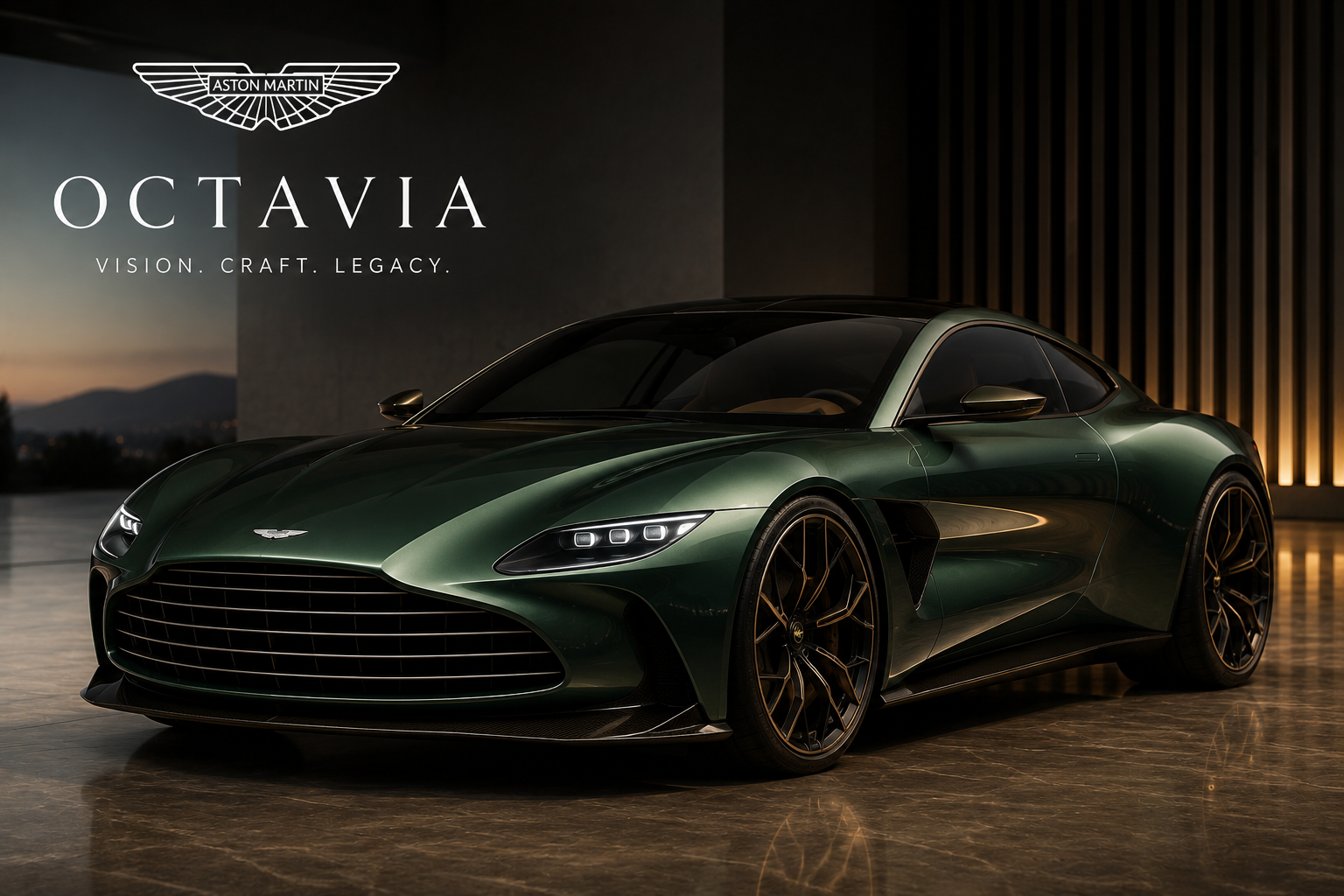
A one-off British grand tourer rebuilt with American muscle, carbon-fiber craftsmanship, and James Bond detail
Ringbrothers is best known for transforming classic American muscle cars, but its most ambitious commission may be a British grand tourer. Octavia began as a 1971 Aston Martin DBS and evolved into a hand-built machine with a completely new carbon-fiber body, a custom performance chassis, modern brakes and suspension, and a supercharged Ford V8. It is not a factory Aston Martin concept or a model destined for dealerships. It is a one-off restomod created for a private client.
For enthusiasts searching for the Aston Martin Octavia, the most important fact is that nearly every visible and mechanical element was redesigned. Ringbrothers retained the identity and basic lineage of the DBS donor, then changed its proportions, structure, powertrain, cabin, and road hardware so extensively that the result is closer to a coachbuilt collector car than a conventional restoration.
| KEY TAKEAWAYS
· Octavia is a one-off Ringbrothers commission based on a 1971 Aston Martin DBS, not an official new Aston Martin production model. · A supercharged 5.0-liter Ford Performance V8 produces 805 horsepower and sends power to the rear wheels through a six-speed manual transaxle. · The wheelbase is three inches longer, while the track is eight inches wider at the front and ten inches wider at the rear. · Its body is made from carbon fiber, and the chassis uses modern independent rear suspension, Fox coilovers, Brembo brakes, and custom HRE wheels. · The public price has not been disclosed, and buyers cannot order Octavia as a regular Ringbrothers or Aston Martin model. |
Aston Martin Octavia Specifications at a Glance
| Category | Octavia Details | Why It Matters |
| Donor vehicle | 1971 Aston Martin DBS | Provides the classic grand-touring identity and legal foundation |
| Engine | Supercharged 5.0-liter Ford Performance V8 | Adds modern power, serviceability, and American muscle character |
| Output | 805 horsepower | Places the one-off build near modern supercar power levels |
| Transmission | Bowler-modified six-speed manual transaxle | Preserves driver involvement and improves weight distribution |
| Drive layout | Rear-wheel drive | Keeps the traditional front-engine GT formula |
| Body | Bespoke carbon-fiber construction | Reduces weight and allows entirely new proportions |
| Chassis | Roadster Shop Fast Track Stage III architecture | Replaces the vintage underpinnings with modern performance hardware |
| Suspension and brakes | Fox RS SV coilovers and Brembo brakes | Supports the higher speed, grip, and stopping demands |
| Production status | Single commissioned vehicle | There is no factory MSRP, trim range, or dealer availability |
What Is the Aston Martin Octavia?
Octavia is Ringbrothers’ interpretation of what a 1970s Aston Martin might become if its original designer had access to modern materials, digital design tools, and contemporary performance engineering. The project was unveiled at The Quail during Monterey Car Week in August 2025. It began with the intention of creating a relatively straightforward restomod, but the scope expanded until almost none of the original vehicle remained visible.
According to Car and Driver’s detailed reveal coverage, the only donor-car components said to remain are the power-window switches. That detail captures the project’s philosophy. Octavia respects the original DBS as inspiration, but it does not attempt to preserve the car in factory condition.
The name is part of the car’s James Bond theme. It refers to Octopussy, while other details include Double-O Silver paint, a SHAKN license plate, an engine dipstick shaped like a martini glass, and valve-cover branding that reads Aston Martini. These touches could have felt gimmicky, but they are integrated as small discoveries rather than dominating the design.
Why Octavia Is Not a New Aston Martin Model
The wording around custom vehicles can create confusion online. Octavia wears Aston Martin styling cues and began with a genuine DBS, but Aston Martin did not design, engineer, certify, or sell it as a current model. Ringbrothers and its specialist partners created the car for one customer.
That distinction affects pricing, availability, warranty expectations, emissions compliance, and comparison shopping. A production grand tourer must satisfy regulations, repeatable manufacturing standards, global service requirements, and thousands of customers. A one-off commission can prioritize craftsmanship, visual impact, and a specific owner’s preferences without needing to become a scalable product.
| Important: There is no official Aston Martin Octavia MSRP, order guide, dealer release date, or production allocation. Any price figure published without confirmation should be treated as an estimate for the private commission, not a retail sticker price. |
A Carbon-Fiber Body With Rewritten Proportions
The original DBS was designed as an elegant four-seat grand tourer with a long hood and formal fastback profile. Ringbrothers preserved that basic visual idea but increased the drama. The wheelbase grew by three inches, the front track widened by eight inches, and the rear track expanded by ten inches. Those changes created the stance required for much broader bodywork and a modern tire footprint.
The body is fully re-created in carbon fiber rather than simply covered with bolt-on fender extensions. This approach allowed designer Gary Ragle and the fabrication team to shape the front fenders, rear haunches, roofline, glass openings, and aero passages as a unified design. The result has the coke-bottle curvature associated with classic performance cars, but the surfaces are tighter and more muscular than those of a stock DBS.
Bespoke three-piece HRE center-lock wheels fill the enlarged arches. Functional openings support brake cooling and heat extraction, while the exterior avoids the visual clutter that often makes heavily modified classics look like track-only machines. Octavia remains recognizable as a luxury GT, even though its dimensions and construction are radically different.
Powertrain: 805 Horsepower and a Six-Speed Manual
The original Aston Martin engine was replaced with a 5.0-liter Ford Performance Coyote V8 built by Wegner Motorsports. A custom 2.65-liter supercharger raises output to 805 horsepower. Ringbrothers also designed a custom exhaust and supporting fuel system for the installation.
The decision to use a Ford-based engine may divide traditionalists. An Aston Martin V8 or V12 would provide stronger brand purity, but the Coyote offers compact dimensions, extensive aftermarket support, high power potential, and a distinctly American sound. It also reflects Ringbrothers’ history rather than pretending the builder has no identity of its own.
A Bowler-modified TR-6060 Magnum six-speed manual is configured as a transaxle. Positioning the gearbox toward the rear can improve front-to-rear weight distribution compared with a conventional transmission mounted directly behind the engine. It also allows Octavia to combine immense output with a mechanical, driver-controlled shifting experience instead of using a modern dual-clutch automatic.
| Powertrain Element | Ringbrothers Choice | Collector and Driving Impact |
| Engine family | Ford Performance 5.0-liter Coyote V8 | Modern parts support and familiar high-performance architecture |
| Forced induction | Custom 2.65-liter supercharger | Creates strong torque and 805-hp output |
| Transmission | Six-speed manual transaxle | Adds involvement and shifts mass rearward |
| Driven wheels | Rear wheels | Maintains classic GT behavior and demands careful throttle control |
| Exhaust | Custom Ringbrothers system | Tailors sound and packaging to the unique body and chassis |
| Published acceleration | Not officially disclosed | Prevents unsupported claims about 0-to-60-mph performance |
Chassis, Suspension, and Braking
A powerful engine alone would not make a convincing grand tourer. Octavia uses a Roadster Shop Fast Track Stage III chassis with independent rear suspension, an integrated structural cage, and a Ford nine-inch rear end from Strange Engineering. The combination is intended to deliver greater rigidity and more predictable suspension geometry than the original 1971 platform.
The suspension uses Fox RS SV fixed-valve coilovers, while C7 Corvette sway-bar components help manage body movement. Large Brembo brakes provide the stopping capability needed for the new power and tire grip. Michelin Pilot Sport Cup 2 tires indicate that outright dry-road performance was prioritized over all-season comfort or wet-weather versatility.
A technical breakdown from Road & Track reports roughly 3,900 hours of design and CAD work plus another 8,200 hours of building and shaping. Those numbers help explain why the chassis, body, interior, and mechanical systems appear integrated rather than assembled from a catalog of unrelated parts.
Interior: British Luxury With Q-Branch Humor
The cabin combines tan leather, carbon fiber, stainless-steel trim, custom gauges, and 3D-printed components. The shift knob, headrest collars, and exterior badges were produced with additive manufacturing, showing how modern fabrication can create low-volume parts with complex shapes and consistent detail.
The bright handbrake resembles a stylized handgun, while the martini-themed dipstick and Aston Martini engine branding continue the Bond references. Gentex supplied electronically dimming sun visors that adjust their transparency as light conditions change. Multiple cameras further support the idea of a classic spy car equipped with discreet modern technology.
The interior does not attempt to look like a restored 1971 cabin. Its controls, materials, and safety structure are visibly custom. That choice makes the car less historically authentic but more consistent with its exterior and mechanical transformation.
Octavia Versus a Stock 1971 Aston Martin DBS
| Area | Original DBS Character | Ringbrothers Octavia |
| Purpose | Luxury grand tourer for series production | One-off high-performance collector commission |
| Body construction | Period steel bodywork | Fully bespoke carbon-fiber body |
| Powertrain | Aston Martin period engine options | Supercharged Ford 5.0-liter V8 with 805 hp |
| Transmission | Period manual or automatic arrangements | Modern six-speed manual transaxle |
| Chassis | Original 1970s structure and suspension | Custom Roadster Shop performance chassis |
| Width and wheelbase | Factory dimensions | Three-inch wheelbase stretch and dramatically wider tracks |
| Interior philosophy | Original luxury cabin and switchgear | Leather, carbon fiber, 3D-printed metal, cameras, and Bond details |
| Collectibility | Historical production Aston Martin | Unique coachbuilt artifact with no direct market comparison |
How Much Does the Aston Martin Octavia Cost?
Ringbrothers has not publicly disclosed the commission price, and there is no retail price because the car is not offered as a production model. The cost would have included the donor DBS, thousands of design and fabrication hours, carbon-fiber tooling and production, custom machining and printing, powertrain development, specialist chassis work, premium paint and upholstery, and the participation of multiple suppliers.
For collectors, the more useful question is not whether Octavia is expensive. It is whether a comparable car could be recreated. The body molds, engineering decisions, client brief, and accumulated labor make an exact duplicate unlikely. A future auction value would depend on provenance, documentation, public recognition, condition, and whether the market views the build as an important moment in the modern restomod movement.
What Makes Octavia Important?
Octavia shows how far the restomod category has moved beyond engine swaps and cosmetic upgrades. The most advanced projects now resemble small-scale automotive development programs. They use digital scanning, CAD, composite body engineering, custom chassis design, additive manufacturing, and supplier partnerships normally associated with specialty manufacturers.
It also demonstrates that a custom car can preserve emotional identity without retaining many original parts. The long hood, fastback roof, four-seat GT proportions, tailored cabin, and Bond references keep the Aston Martin story visible. At the same time, the Ford V8, widened body, manual transaxle, and Ringbrothers details make the builder’s authorship impossible to miss.
That balance is likely to determine how Octavia ages. Purists may question the American engine and extensive changes. Other collectors will see a confident reinterpretation that treats the donor as a starting point rather than a museum object.
Strengths and Possible Tradeoffs
| Potential Strength | Why Enthusiasts May Value It | Possible Tradeoff |
| One-off status | True exclusivity and strong event provenance | No direct replacement parts, pricing guide, or production support |
| 805-hp manual powertrain | Rare combination of extreme power and driver involvement | Heat, traction, noise, and drivability require careful calibration |
| Carbon-fiber body | Allows dramatic shape changes and lower mass | Repair work may require specialist composite expertise |
| Modern chassis hardware | Improved rigidity, grip, braking, and control | Less original Aston Martin engineering remains |
| Bond-inspired details | Adds personality and rewards close inspection | Some traditionalists may prefer a more restrained theme |
| American V8 | Strong performance and broad parts knowledge | Brand purists may prefer an Aston Martin engine |
Frequently Asked Questions
Is the Aston Martin Octavia a production car?
No. It is a one-off Ringbrothers commission based on a 1971 Aston Martin DBS. It is not part of Aston Martin’s current production lineup.
Who built Octavia?
Ringbrothers led the project with designer Gary Ragle and specialist partners that contributed the carbon body, chassis, wheels, brakes, suspension, electronic components, machining, and other custom systems.
What engine does Octavia use?
It uses a supercharged 5.0-liter Ford Performance Coyote V8 built by Wegner Motorsports. Published output is 805 horsepower.
Does it have an automatic transmission?
No. Power goes through a Bowler-modified six-speed manual transaxle to the rear wheels.
How fast is the Aston Martin Octavia?
The builder has published the 805-hp output, but verified acceleration, top-speed, lap-time, and curb-weight figures have not been publicly released. Estimates should not be presented as tested results.
Why is it called Octavia?
The name and several small details reference James Bond and the film Octopussy. Other theme elements include Double-O Silver paint, a martini-shaped dipstick handle, and Aston Martini valve-cover lettering.
Can someone order another one?
No standard order program has been announced. A collector could commission a different custom build, but Octavia itself was designed as a unique vehicle for one client.
Is it still a real Aston Martin?
It began with a genuine 1971 Aston Martin DBS and retains that vehicle’s identity and inspiration. However, most visible, structural, and mechanical elements are custom Ringbrothers components, so it is best described as a heavily coachbuilt DBS restomod.
Final Verdict
Octavia is less a restored Aston Martin than a new car built around the memory of one. Its 805-hp supercharged V8, manual transaxle, carbon-fiber body, widened stance, modern chassis, and meticulously themed cabin turn the elegant DBS formula into a modern British-American muscle GT. It will not satisfy every originality-focused collector, but that is not its purpose. The project succeeds by being unmistakably inspired by Aston Martin while remaining unmistakably a Ringbrothers creation.
Related Reading for Buyers and Collectors
Readers comparing the philosophy behind this project may also find this guide to modern restomod engineering useful for understanding how contemporary builders combine classic design with new structures, engines, and electronics.
For broader brand context, this overview of Aston Martin grand tourers explains how the company’s front-engine luxury performance formula developed across different generations.





Comments