
 By
By 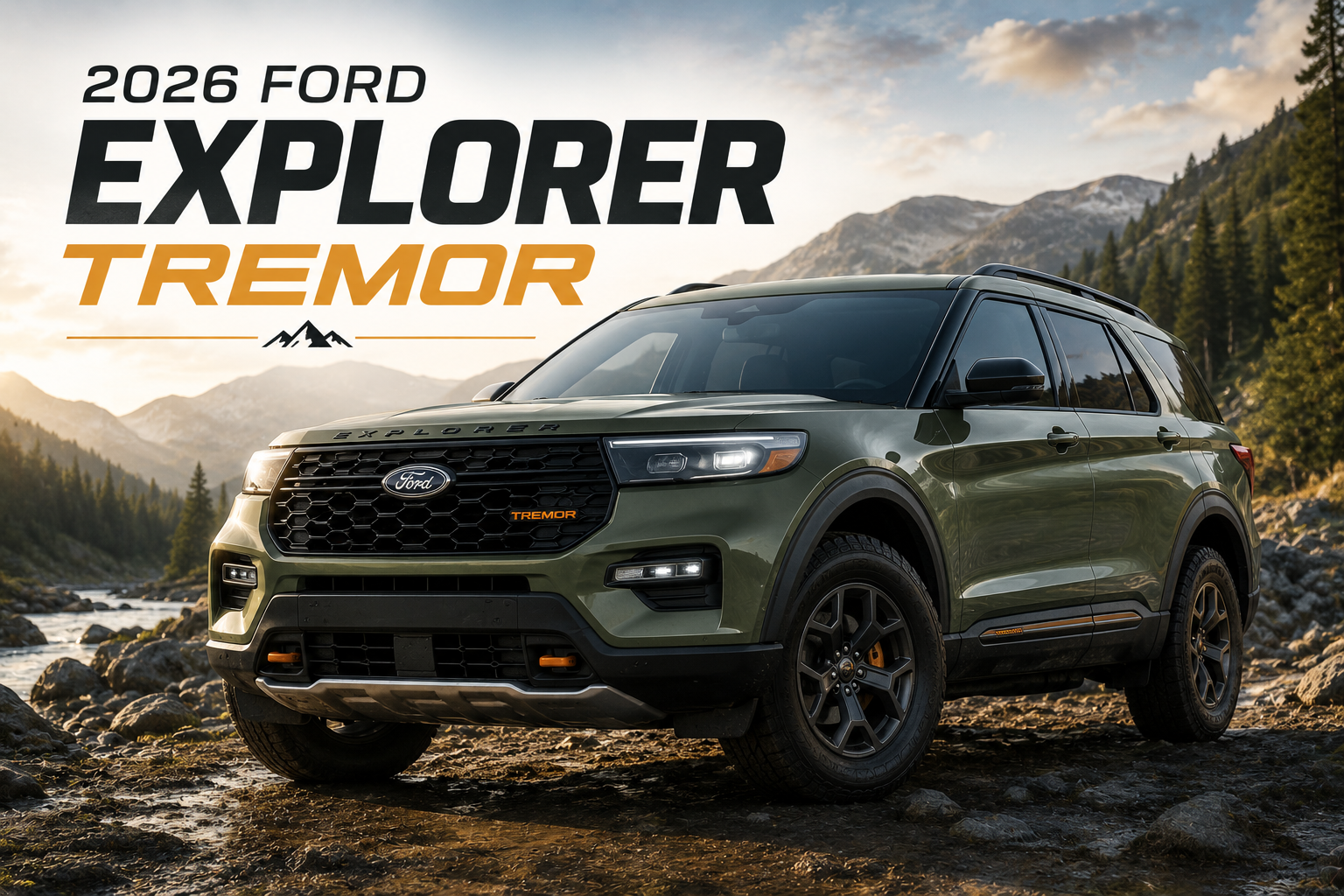
A practical look at the two engines, off-road hardware, family space, fuel economy, pricing, and the limits of Ford’s adventure-focused three-row SUV
| 2026 Explorer Tremor fact | Details |
| Vehicle type | Six-seat, three-row midsize SUV with standard Intelligent 4WD |
| Standard engine | 2.3-liter turbocharged four-cylinder, 300 hp and 310 lb-ft |
| Available engine | 3.0-liter twin-turbo V6, currently listed by Ford at up to 385 hp and 415 lb-ft |
| Transmission | 10-speed automatic |
| Ground clearance | 8.7 inches |
| Off-road hardware | Torsen limited-slip rear axle, all-terrain tires, skid protection, tow hooks, trail camera, and lifted suspension |
| Maximum towing | 5,000 pounds when properly equipped |
| Fuel economy | 2.3L: 19/23/21 mpg; 3.0L: 17/22/19 mpg city/highway/combined |
| Cargo volume | 16.3 cu ft behind row three, 46 behind row two, and 85.3 behind row one |
| Best value | The 2.3-liter Tremor unless strong acceleration and the bundled luxury equipment are priorities |
Key Takeaways
- The Tremor replaces the old Timberline and adds the Explorer’s available twin-turbo V6 for the first time.
- Both engines receive the same core off-road hardware, so the expensive V6 does not unlock a higher tow rating or a more capable transfer case.
- The four-cylinder is quick enough for most families and returns better fuel economy, making it the rational choice.
- The Tremor is excellent for snow, gravel, forest roads, camping access, and moderate trails, but it is not a substitute for a Bronco with low-range gearing.
The 2026 Ford Explorer Tremor is aimed at families who want more trail ability than a normal three-row crossover without accepting the noise, ride compromises, or packaging limits of a hard-core off-roader. It combines a lifted suspension, all-terrain tires, underbody protection, a rear limited-slip differential, and a modern six-seat cabin.
Its biggest buying decision is the engine. The standard 300-hp turbo four already provides useful performance, while the available twin-turbo V6 adds a dramatic power increase but also pushes the vehicle into a much higher price bracket. The better choice depends on whether the buyer values acceleration and bundled luxury features more than fuel economy and overall value.
| Bottom-line recommendation
Buy the 2.3-liter Tremor for the best blend of price, trail equipment, family comfort, and fuel economy. Choose the V6 only when strong passing power, quick acceleration, and the additional premium equipment are important enough to justify the cost. |
What Changed From the Explorer Timberline?
Ford offered the Explorer Timberline from 2021 through 2024, then removed it while the rest of the Explorer received a major interior refresh for 2025. The Tremor brings that adventure formula back for 2026 with a new name, updated styling, the redesigned dashboard, and access to the high-output V6 that the Timberline never offered.
Most useful Timberline hardware remains, including 18-inch all-terrain tires, skid protection, tow hooks, auxiliary lights, increased ride height, and a Torsen limited-slip rear axle. Electric Spice accents give the Tremor a distinct identity.
2.3-Liter vs. 3.0-Liter V6
| Engine choice | Output | EPA economy | Best for |
| 2.3L EcoBoost four-cylinder | 300 hp, 310 lb-ft | 19 city / 23 highway / 21 combined | Value, commuting, family use, light towing, and occasional trails |
| 3.0L EcoBoost twin-turbo V6 | Ford currently lists up to 385 hp, 415 lb-ft | 17 city / 22 highway / 19 combined | Fast acceleration, mountain passing, and buyers who want the bundled premium equipment |
Ford’s current Explorer Tremor model page displays a $48,965 starting MSRP, 5,000 pounds of maximum towing, and up to 385 horsepower from the available 3.0-liter V6. Early 2026 drive reports listed the V6 at 400 horsepower, so shoppers should confirm the output and package content on the exact window sticker.
The four-cylinder should reach 60 mph in roughly six seconds based on the previous Timberline, which is plenty for freeway merging and family travel. The V6 is expected to cut that time to the low-five-second range. That difference is immediately noticeable, but it does not change the maximum 5,000-pound tow rating or add low-range gearing.
The V6 was introduced through a large package that also bundled features such as a 14-speaker B&O audio system, a fixed glass roof, rain-sensing wipers, massaging front seats, and a power-folding third row. This makes the upgrade easier to appreciate as a luxury-and-performance package, but harder to justify for a buyer who only wants the stronger engine.
On-Road Driving: More Comfortable Than the Tires Suggest
During the supplied Car and Driver first drive, the Tremor remained composed on freeways and desert roads, with smooth damping and controlled body motion. The publication estimated 0 to 60 mph in about 5.3 seconds for the V6 and 6.0 seconds for the four-cylinder, while also noting that the steering was acceptable rather than especially communicative.
The all-terrain tires add some road noise and reduce steering precision, but the Tremor avoids a punishing ride. It feels like a family Explorer first and an off-road package second.
Off-Road Ability and Its Limits
The Tremor has 8.7 inches of ground clearance, a 24.1-degree approach angle, a 23.7-degree departure angle, and an 18.7-degree breakover angle. Its rear-based four-wheel-drive layout gives it a useful advantage when climbing loose grades, and the trail-camera views help the driver place individual wheels around rocks or narrow obstacles.
| Terrain or task | Tremor ability | Important limit |
| Snow, gravel, and muddy access roads | Strong | Tire condition and driver judgment still matter |
| Forest roads and camping trails | Strong | Watch the long wheelbase and low body edges |
| Moderate rocky terrain | Capable with careful line choice | No low-range transfer case |
| Deep articulation with a wheel in the air | Limited | The Torsen differential needs resistance at both rear wheels |
| Serious crawling or repeated hard impacts | Not recommended | A Bronco or body-on-frame SUV is more appropriate |
The Torsen rear differential works well on pavement, gravel, and loose surfaces, but it is less effective when one rear wheel is completely unloaded. Careful line selection or light brake application may be needed to restore torque transfer. This is a reminder that the Tremor is an adventure-oriented crossover, not a rock crawler.
Interior, Seating, and Cargo Space
The cabin is one of the biggest improvements over the old Timberline. A 13.2-inch center display runs Ford Digital Experience with Google-based features, wireless Apple CarPlay, and wireless Android Auto. A 12.3-inch digital cluster, a 10-speaker B&O audio system, a heated steering wheel, heated and ventilated front seats, and heated second-row captain’s chairs are standard.
The Tremor seats six because the second row uses captain’s chairs. Cargo space measures 16.3 cubic feet behind the third row, 46 cubic feet behind the second, and 85.3 cubic feet behind the first. The third row is useful for children and shorter adults, but luggage room becomes limited when all three rows are occupied.
Technology, Towing, and Fuel Costs
A 360-degree camera is standard and useful on trails, in parking garages, and when lining up a trailer. BlueCruise is available but requires an active plan, so include subscription cost in the comparison.
Both engines can tow up to 5,000 pounds when properly equipped. That is sufficient for many small boats, utility trailers, and compact campers, but the vehicle’s door-jamb payload label must also cover passengers, cargo, accessories, and trailer tongue weight. The V6 provides stronger acceleration with a trailer but does not raise the official tow ceiling.
Fuel economy favors the four-cylinder by 2 mpg combined. At 12,000 miles per year, the 21-mpg four-cylinder would use about 571 gallons, while the 19-mpg V6 would use about 632 gallons. The difference is roughly 61 gallons annually before considering that driving style, roof accessories, terrain, and towing can reduce real-world mileage.
Price and Value Verdict
The base Tremor competes with rugged versions of the Honda Pilot, Chevrolet Traverse, Kia Telluride, and similar three-row SUVs. Its strengths are the rear-based drivetrain, real skid protection, excellent ground clearance, useful trail cameras, and the option of substantially more power than most direct competitors.
The weakness is the V6 price structure. Early launch pricing put the four-cylinder around $50,000 and a V6 configuration with required equipment above $62,000. At that level, buyers should also compare larger body-on-frame SUVs, a four-door Bronco, and luxury-oriented three-row crossovers. The four-cylinder Tremor preserves the model’s strongest value argument.
| Best configuration
Choose the 2.3-liter Explorer Tremor with only the options your family will use. Add the V6 when acceleration is a genuine priority and you also want the premium audio, seating, roof, and convenience features bundled with it. |
Who Should Buy the Explorer Tremor?
- Families who regularly drive on snow, gravel, forest roads, or rough campground access routes.
- Buyers who need three rows but do not want a large body-on-frame SUV.
- Drivers who value a comfortable highway ride more than maximum rock-crawling ability.
- Owners towing small recreational trailers within the 5,000-pound limit.
- Performance-minded shoppers who accept the V6 package cost for unusually strong acceleration.
Skip it when seven seats are essential, fuel economy is the top priority, or the vehicle will be used for hard-core off-roading. A regular Explorer may be more efficient, while a Bronco or body-on-frame SUV provides more specialized trail hardware.
Frequently Asked Questions
How much is the 2026 Explorer Tremor?
Ford currently displays a $48,965 starting MSRP, while early drive-review pricing listed $50,160. Confirm the final amount on the window sticker.
Does the Explorer Tremor have four-wheel drive?
Yes. Intelligent 4WD is standard, along with a Torsen limited-slip rear axle and selectable drive modes.
Is the V6 worth the extra money?
It is worth considering for buyers who prioritize quick acceleration and want the bundled premium equipment. The four-cylinder is the better value for most families.
Can the Tremor tow more with the V6?
No. Ford lists a maximum towing capacity of 5,000 pounds for the model when properly equipped.
How many people does it seat?
The Tremor seats six because it uses second-row captain’s chairs and a two-person third-row bench.
Is it as capable as a Ford Bronco?
No. The Tremor has useful clearance, tires, skid plates, and traction hardware, but it lacks the Bronco’s low-range transfer case and more specialized off-road geometry.
Final Verdict
The Explorer Tremor combines genuine rough-road upgrades with the comfort and space expected from a family SUV. The four-cylinder is the smart purchase because it keeps the same trail hardware, tow rating, technology, and cabin benefits while costing less and using less fuel. The V6 is impressively quick, but its expensive package makes it a want rather than a need.




Comments