
 By
By 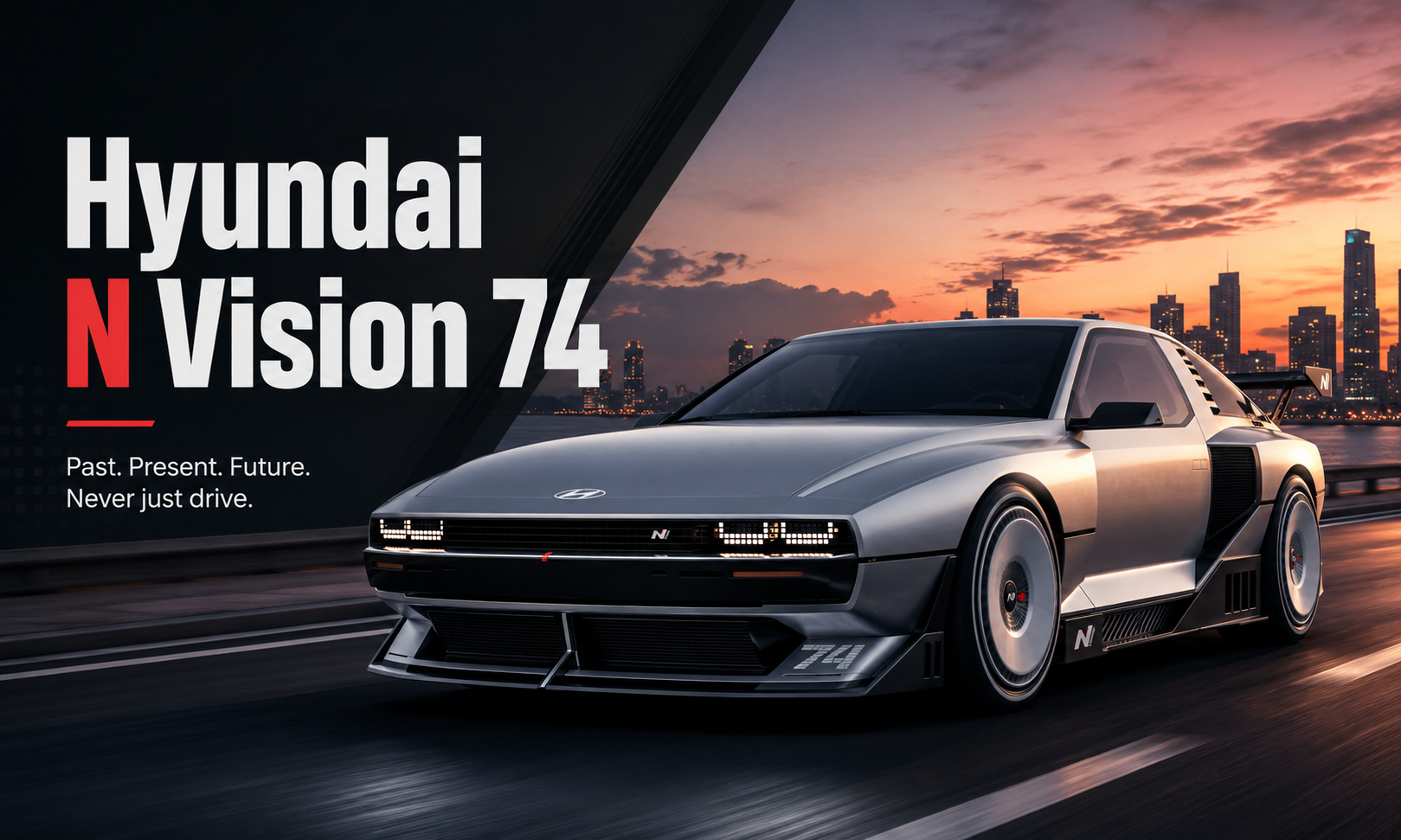
Why this retro-futuristic hydrogen-electric coupe became an instant icon, how its unusual drivetrain works, and which ideas may reach future Hyundai N cars
| N Vision 74 fact | Details |
| Vehicle type | Two-seat, two-door hydrogen-electric high-performance rolling lab |
| Debut | 2022 |
| Layout | Dual rear motors with rear-wheel drive |
| Motor output | Over 500 kW, approximately 670 horsepower |
| Maximum torque | Over 900 Nm, approximately 664 lb-ft |
| Battery | 62.4-kWh pack with 800-volt fast-charging capability |
| Hydrogen system | 4.2 kg total tank capacity and an 85-kW net fuel-cell stack |
| Claimed range | More than 600 km, approximately 373 miles |
| Refueling time | About 5 minutes under Hyundai test conditions |
| Claimed top speed | More than 250 km/h, approximately 155 mph |
| Current status | Rolling-lab prototype with no announced U.S. price or on-sale date |
| Key takeaways
The N Vision 74 is a real, drivable prototype rather than a static show car. Its battery supplies the high-output rear motors, while a hydrogen fuel cell helps maintain energy and extend range. The project also tests independent rear-motor torque control, advanced cooling, and a design inspired by Hyundai’s 1974 Pony Coupe. As of July 2026, Hyundai still presents it as a rolling lab rather than a retail model. |
For readers searching for n vision 74 Hyundai, the simplest description is a hydrogen-electric super-coupe built to test future performance technology. It combines a large battery, a fuel-cell system, twin rear motors, active torque vectoring, and styling that connects Hyundai’s earliest sports-car ambition with its modern N performance brand.
It is also important to separate the prototype from production rumors. Hyundai has demonstrated the car on track and published detailed specifications, but it has not announced a U.S. price, order process, or retail launch date. The vehicle matters because of the engineering it proves, even if the exact coupe never reaches showrooms.
What Is the Hyundai N Vision 74?
Hyundai calls the N Vision 74 a rolling lab. That term describes a fully functioning development vehicle used to test hardware and software that may later appear in production cars. Unlike many concepts that only move slowly for photography, this one was built to accelerate hard, corner at speed, manage heat on a track, and generate repeatable data.
The supplied Car and Driver prototype drive explains that four engineering prototypes were developed around a modified Kia Stinger structure. The test car used two independent 335-hp rear motors, a 62.4-kWh battery, and a fuel-cell system derived from Hyundai’s hydrogen work. The drive report praised the direct acceleration and natural rear-axle behavior while noting wooden brake feel and the prototype’s roughly two-ton weight.
The Stinger connection does not mean the exterior is simply a rebodied production coupe. The structure gave engineers a suitable platform on which to package the experimental energy system, cooling circuits, control units, and twin-motor rear axle before the dramatic N Vision body was added.
How the Hydrogen-Electric Powertrain Works
The N Vision 74 is neither a conventional battery EV nor a typical fuel-cell vehicle. Its rear motors receive electricity from the battery, which provides the large bursts of power required for acceleration and drifting. The fuel cell converts stored hydrogen into electricity and supports the battery, helping the car sustain performance and extend driving range.
| Component | Role in the system | Why it matters |
| 62.4-kWh battery | Supplies high-output electrical energy to the rear motors | Delivers immediate performance and can use 800-volt fast charging |
| Hydrogen fuel-cell stack | Generates electricity from hydrogen and oxygen | Supports range and helps maintain energy during sustained use |
| Twin hydrogen tanks | Store 4.2 kg of hydrogen near the rear axle | Enable quick refueling under suitable conditions |
| Two rear motors | Drive the left and right rear wheels independently | Allow precise torque distribution without a mechanical differential |
| Three cooling circuits | Manage the fuel cell, battery, motors, and power electronics | Reduce heat-related power loss during demanding driving |
This layout addresses two weaknesses that can affect high-performance electrified vehicles. A battery can deliver enormous power but loses usable energy during extended track driving, while a fuel cell alone may not react quickly enough to supply maximum motor demand. Combining them lets the battery handle the peaks and the fuel cell contribute steady energy.
Performance and Driving Character
Hyundai lists total rear-motor output above 500 kW and torque above 900 Nm. That translates to approximately 670 horsepower and 664 lb-ft. The company claims acceleration from zero to 100 km/h in less than four seconds, a top speed above 250 km/h, and more than 600 km of combined driving range.
| Performance item | Published figure | Status |
| Combined power | Over 500 kW, about 670 hp | Hyundai specification |
| Combined torque | Over 900 Nm, about 664 lb-ft | Hyundai specification |
| 0 to 100 km/h | Less than 4.0 seconds | Hyundai claim |
| 0 to 60 mph | Approximately 3.5 seconds | Car and Driver estimate |
| Top speed | Over 155 mph | Hyundai claim |
| Curb weight | Approximately 4,400 pounds | Car and Driver estimate |
The most interesting part of the drive is not the acceleration number. Each rear wheel has its own motor, so software can change the amount of torque sent left or right almost instantly. The system can stabilize the car, help it rotate into a corner, maximize traction on exit, or permit a controlled slide. Car and Driver reported that the behavior felt natural rather than artificial, even though no physical differential connected the rear wheels.
The prototype was not perfect. Its mass challenged the brakes, and the engineering cabin and underlying structure were not ready for retail use. Those weaknesses are normal for a rolling lab. The vehicle exists to reveal problems under demanding conditions before related ideas are engineered into a production platform.
Design: The 1974 Pony Coupe Reimagined
The N Vision 74 looks futuristic, but its basic shape comes from Hyundai history. In 1974, Hyundai showed the Pony Coupe concept designed by Giorgetto Giugiaro. The original wedge-shaped coupe never reached production, yet it represented the young company’s ambition to build something more emotional than basic transportation.
The modern concept carries over the low roof, long fastback profile, distinctive B-pillar, and crisp geometric surfaces. Pixel headlights and taillights connect the design to current Hyundai EVs, while the large rear wing, side intakes, broad fenders, splitter, and diffuser support cooling and aerodynamics rather than serving only as decoration.
Hyundai’s current official N Vision 74 specification page lists a length of 4,952 mm, a width of 1,995 mm, a height of 1,331 mm, and a 2,905-mm wheelbase. In U.S. measurements, that is about 195 inches long, 78.5 inches wide, 52.4 inches tall, and 114.4 inches between the axles.
Interior and Practicality
The cabin mixes a classic driver-focused layout with digital displays and motorsport equipment. Physical buttons remain important, the seats provide strong support, and Performance Blue accents connect the car to Hyundai N road models. The prototype also includes a roll cage and development hardware that would not appear unchanged in a customer vehicle.
Practicality was not the main goal. It is a two-seat coupe with a complex energy system, wide body, low roof, and limited space for luggage. A production interpretation would require crash certification, quieter operation, storage solutions, climate systems, easier entry, and packaging suitable for everyday roads.
Will the N Vision 74 Go Into Production?
No retail version has been officially announced. The 2022 prototype drive reported that Hyundai had no plans to produce the car at that time. As of July 2026, Hyundai still categorizes the N Vision 74 as a rolling lab and does not publish a price, model year, reservation page, or U.S. release schedule.
| Question | Confirmed information | What remains unknown |
| Is the prototype real? | Yes. Multiple drivable engineering vehicles were built and tested. | How much of the original hardware would survive production. |
| Is a production car confirmed? | No public production announcement appears on Hyundai’s official model page. | Whether Hyundai will approve a limited coupe in the future. |
| Is there a price? | No official MSRP exists. | A retail price, trim structure, and market allocation. |
| Is there a U.S. release date? | No official on-sale date has been announced. | Whether a future version would meet U.S. infrastructure and certification needs. |
| Could the technology appear elsewhere? | Yes. Rolling labs are intended to develop ideas for later N products. | Which system will appear first and in what type of vehicle. |
| Do not treat rumor pricing as official
Any price, production quantity, model year, or launch date published without a direct Hyundai announcement should be treated as speculation. The safest description remains a drivable development concept with technologies that may influence future N vehicles. |
What Could Reach Future Hyundai N Cars?
- Independent left-right motor control that changes cornering behavior through software.
- Track-focused thermal management that protects performance during repeated hard use.
- Integrated control of a battery and a second energy source.
- Driver-focused physical controls combined with modern digital displays.
- Retro design cues that reinterpret Hyundai heritage without copying an old car.
Some of these lessons are useful even without hydrogen. Twin-motor torque vectoring, cooling logic, brake integration, and performance software can be adapted to battery-electric N models. The concept therefore has value whether or not a customer ever buys a car with the N Vision 74 name.
Frequently Asked Questions
Is the Hyundai N Vision 74 a real working car?
Yes. It is a functioning development prototype that has been driven on a racetrack. It is not merely a non-running display model.
Is it a hydrogen car or an electric car?
It is both. Electric motors drive the rear wheels, a battery provides high-output energy, and a hydrogen fuel cell generates electricity to support the system and extend range.
How much horsepower does it have?
Hyundai lists more than 500 kW of rear-motor output, which is approximately 670 horsepower. Car and Driver described two 335-hp rear motors.
How fast is the N Vision 74?
Hyundai claims zero to 100 km/h in under four seconds and a top speed above 250 km/h, or approximately 155 mph.
Can I buy one in the United States?
No retail version, U.S. price, or order process has been announced as of July 2026.
Why is it called N Vision 74?
N identifies Hyundai’s performance brand, Vision reflects its role as a future-focused rolling lab, and 74 refers to the 1974 Pony Coupe concept that inspired the design.
Is it based on the DeLorean?
No. Hyundai identifies the 1974 Pony Coupe as the direct inspiration. The visual resemblance is understandable because Giorgetto Giugiaro was connected to both design histories.
Final Verdict
The N Vision 74 is important because it makes experimental engineering desirable. Its hydrogen-electric system, twin rear motors, active torque control, cooling strategy, and 1970s-inspired design turn a development vehicle into one of Hyundai’s most memorable concepts.
The production question remains unanswered, and buyers should ignore unofficial pricing or release dates. Even so, the car has already achieved its main purpose: it proves that future Hyundai performance vehicles can combine advanced electrification with personality, heritage, and genuine driver involvement.




Comments